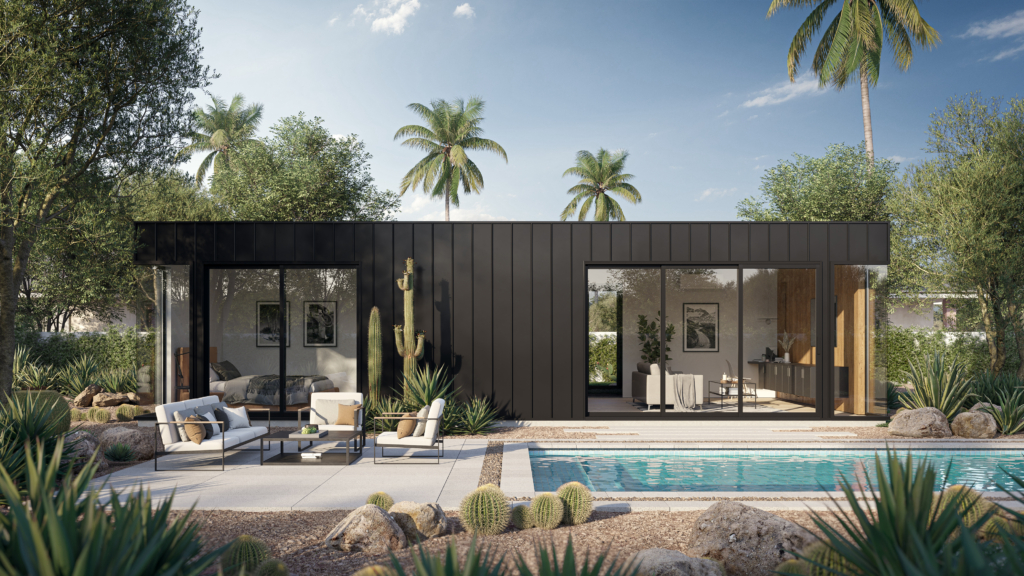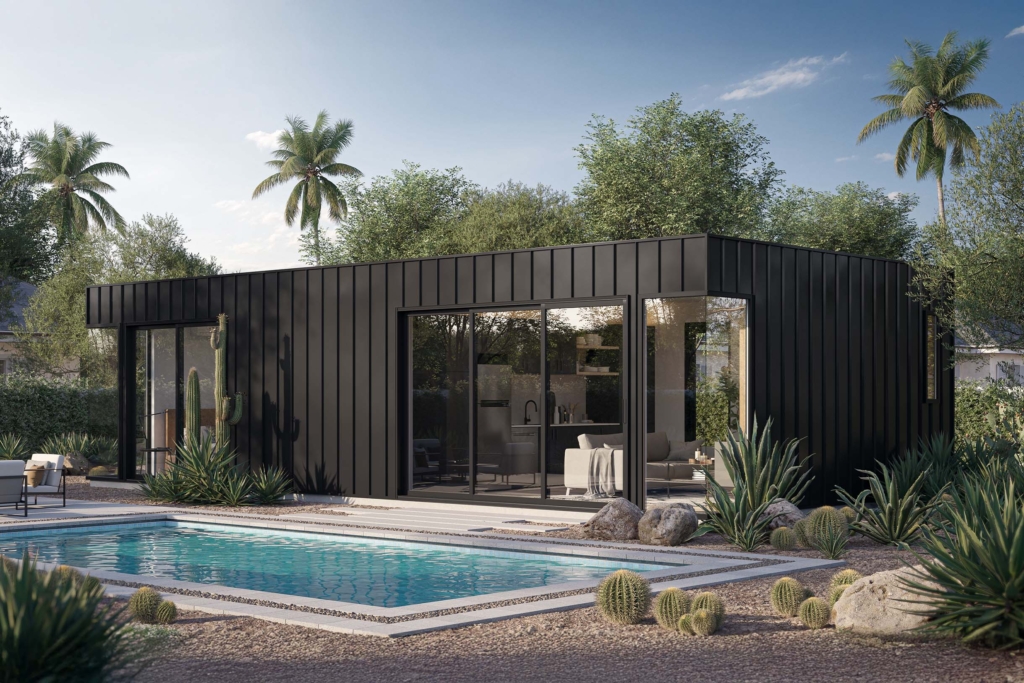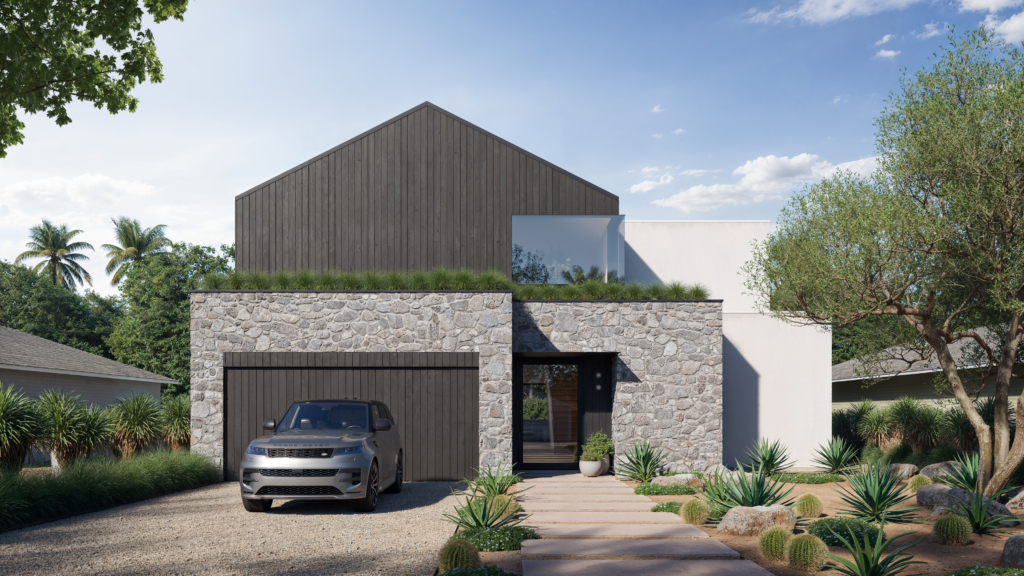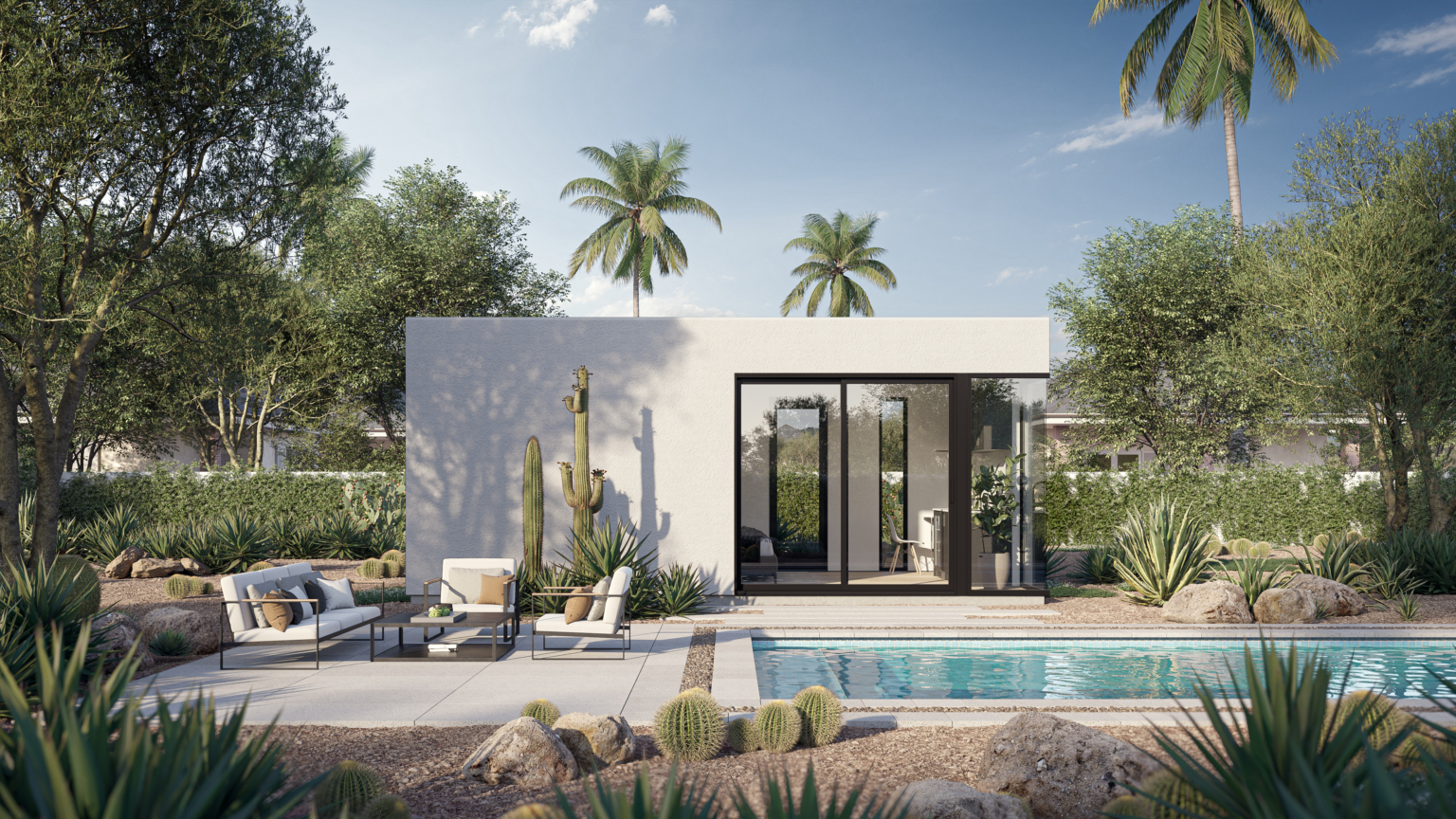
Walk into any Phoenix home builder’s office and mention you want the see the modular ADUs with basements, and you may see some expressions shift to confusion or concern.
The truth about building basements under ADUs in Arizona is like a poorly kept secret at a neighborhood barbecue – everyone knows it’s complicated, but nobody wants to be the first to explain exactly why.
Adding a basement to a modular home costs $20,000 to $29,000 on average nationwide.
But in Arizona?
Double that, then add the cost of a jackhammer operator’s therapy sessions after encountering caliche.
We’ve been building custom ADUs and guest homes at Minimal Living Concepts long enough to know that what works in Michigan doesn’t necessarily translate to the Sonoran Desert.
And when it comes to modular ADUs with basements, the desert has its own rules – ones written in calcium carbonate and enforced by expansive clay soils that affect foundations across Arizona.
The Modular ADUs with Basements vs. Arizona’s Underground Reality
Modular ADUs seduce with their efficiency.
Factory-built precision, weather-independent construction, and that magical promise of 10% to 20% cheaper than traditional homes according to industry data.
For homeowners looking to add an ADU for aging parents or rental income, these promises sound perfect.
But the brochures won’t be so upfront about how modular homes require permanent foundations – and in Arizona, “permanent” and “underground” have a complicated relationship.
The average cost of building a foundation for a modular home is $6,000 to $20,000 nationally.
In Phoenix, we’re looking at the high end of that range before we even start dealing with our special desert challenges – challenges that make traditional ADU construction more practical.
The Factory Floor Meets Desert Floor
We recently consulted with a family who’d fallen in love with the modular ADU concept.
They wanted to maximize their property value with a guest home that included basement storage.
They’d done their homework, selected a reputable manufacturer, even picked out their floor plan.
What they hadn’t factored in was that their North Scottsdale lot sat on what contractors affectionately call “God’s concrete” – caliche so dense it might as well be bedrock.
The foundation that would have cost $15,000 in Ohio was around $45,000 after factoring in specialized excavation equipment and extended labor hours.
And that’s before even considering Arizona’s current ADU framework under House Bill 2720 and the applicable local permitting requirements.
Breaking Down the Real ADU Basement Costs
You’ll hear some numbers that we’d consider the more optimistic projections from modular home manufacturers who’ve never tried to dig under an Arizona ADU.
But we’re inclined to underpromise and overdeliver – which means to say, we strive for realism when it comes to costs.
According to HomeGuide’s 2024 foundation cost data, a basic poured basement with 8-foot walls, an egress window, insulation, and stairs will cost between $35,000 to $40,000 for a 1,600 SF home.
And after that, for a typical ADU of 600-800 square feet, you’re still looking at $25,000-$30,000 before Arizona-specific challenges:
- Caliche removal: $10,000-$20,000
- Soil stabilization for expansive clays: $5,000-$15,000
- Enhanced waterproofing: $8,000-$12,000
- Specialized drainage: $5,000-$10,000
Total ADU basement cost: $53,000-$87,000
The thing is, modular homes can’t sit on simple concrete slabs.
They typically require basement or pier-and-beam foundations with crawl spaces.
Even if you wanted to skip the basement entirely, you’re still going to be looking at significant foundation costs that could eat up your entire ADU budget.
Our approach with models like the Flex Studio Addition uses traditional construction methods that allow for more foundation flexibility – something that matters when every cubic yard of excavation costs a premium.
Why ADU Basements Are Rare in Arizona
People assume we don’t build basements under ADUs because it’s hot.
But we believe the real reasons run deeper – quite literally so.
Arizona’s expansive soils contain high clay content and can shrink and expand significantly with moisture changes.
You could find yourself building your dream ADU basement for storage or utilities, only to watch it crack like an egg as the surrounding soil plays accordion with every monsoon season.
The Caliche Chronicles
Caliche is prevalent throughout Arizona, particularly the Sonoran Desert.
This calcium carbonate-rich layer is incredibly difficult to excavate, requiring powerful machinery and significant investment – costs that can make your ADU timeline stretch from 8 months to over a year.
We’re talking about a naturally occurring cement layer that laughs at standard excavation equipment.
Breaking through caliche requires specialized tools that can add $100 to $200 per cubic yard to your excavation costs.
And for even a small ADU basement, you’re looking at removing hundreds of cubic yards.
Modular ADUs and Foundation Requirements
Modular ADUs arrive at your site in pieces – large, heavy, precisely engineered pieces that need a foundation capable of supporting them without any flex or movement.
Unlike traditional ADU construction where we build up from the foundation, adapting as we go, modular homes demand perfection from day one.
The foundation must be exactly level, precisely squared, and strong enough to support the concentrated loads of the module connection points.
We’re really not exaggerating – so the truth is, you may well be looking at costly modifications or structural issues that could violate Arizona’s ADU requirements.
Modular home delivery costs average $5,000 to $15,000, assuming the house is being built in your region and your site is ready and accessible.
In Arizona’s established neighborhoods where ADUs are most popular, delivery becomes its own adventure.
The Hidden Economics of Underground ADUs
About 16.6 percent of homes built in the U.S. in 2023 had basements, compared with about 37 percent in 2000, according to Census Bureau data.
Arizona’s percentage varies year by year, but it’s always less than 5%, and for ADUs it’s virtually zero.
Here’s what those same dollars could buy you with traditional ADU construction from MLC:
Our Live One-Bedroom provides expanded living areas above ground, where you can actually enjoy Arizona’s practically-year-round days of sunshine.
And – you can do that for less than the cost of excavating and waterproofing a basement.
Site Preparation: Where ADU Dreams Meet Caliche
Arizona’s hard, compact soils become almost concrete-like when dry.
And in our experience, that’s on a good day.
Frankly, on a bad day, you could hit a caliche shelf that extends across your entire ADU building footprint.
Standard excavation in most parts of the country: $3-$5 per cubic yard.
Arizona excavation through caliche: $15-$25 per cubic yard.
And then, some sites require controlled blasting, which opens up a whole new world of permits, insurance, and neighbor relations – particularly challenging when you’re building an ADU in an established neighborhood. The Phoenix ADU permit process guide shows where site and plan reviews enter the schedule.
We worked with a client last year whose modular ADU plan included a basement.
The excavation quote came in at $78,000, more than the cost of our entire M1 ADU model.
They pivoted to traditional construction with a slab foundation and used the savings to upgrade to our M3 model with premium finishes.
Traditional ADU Construction vs. Modular: The Foundation Debate
Traditional ADU construction shows its flexibility in a few ways – but here’s one reason why we favor the traditional approach. Our site-built versus modular ADU comparison covers the broader differences beyond foundations.
Modular homes are fixed to a solid basement foundation, but that foundation must be perfect before the first module arrives.
You really can’t be making last-minute adjustments, field modifications, or working around unexpected site conditions without risking the need to scrap almost everything and start again.
We’re drawn to traditional construction precisely because it allows us to adapt as we build.
Hit unexpected rock? We can adjust.
Find the water table higher than expected? We can modify our approach without sending modules back to the factory.
Plus, there’s the bonus that banks understand traditional construction.
According to the National Association of Home Builders, traditional construction financing is available from virtually every lender.
Modular ADU construction loans, especially for properties with complex foundation requirements, often require specialized lenders with higher rates.
Our guide to financing an ADU in Arizona helps navigate these complexities, including HomesStyle Renovation Loans.
Alternative ADU Solutions That Actually Work
Instead of fighting the desert, we’ve learned to work with it.
Here are alternatives that deliver the benefits of basement storage without the astronomical costs:
Above-Ground ADUs with Storage: Our Live+ model includes smart storage solutions that eliminate the need for basement space while providing all the functionality you need.
Detached ADU Structures: Our custom ADU designs offer the extra space you’re looking for without going underground.
A detached studio provides storage, living space, or rental income potential, all while sitting sensibly on a slab foundation.
Two-Story ADUs: Generally, it is cheaper to build up rather than excavate, according to construction cost analysis.
Our Dwell Two-Bedroom Home maximizes vertical space while keeping you above our challenging soils.
Making Smart ADU Choices for Desert Living
We’ve now spent so many years building ADUs in Arizona, and we’ve learned that the best ADU isn’t always the one that fights hardest against nature.
ADUs need to work with – not against – what we have.
As we’ve explained in our comparison of ADUs versus tiny homes, understanding local conditions is important in for so many reasons that we honestly won’t be able to list them all here.
At MLC, we use optimized traditional construction methods.
Traditional construction methods are accepted and easily permitted in every city, neighborhood, and municipality within the Valley.
This is how we dodge surprises, hedge foundation nightmares, and avoid having to force Midwest solutions onto desert ADU challenges.
Our process includes touring completed ADUs so you if you’d like to, you can see exactly what you’re getting.
We pride ourselves on both our desert-adapted designs and our transparency.
Conclusion
The dream of a modular ADUs with basements makes perfect sense – in Ohio.
In Arizona, it’s like planning an ice fishing tournament in August – technically possible, but unnecessarily expensive – and missing the point of building beyond the main house in our desert climate.
By now, we’ve built enough ADUs in this desert to know that success doesn’t come from importing solutions from other climates.
It comes from understanding what works here and building accordingly.
Whether you’re a real estate agent exploring our referral program or a homeowner ready to add value to your property, we focus on solutions that embrace desert living.
Modular ADUs have their place, and basements have their place.
In Arizona, those places rarely overlap without significant financial friction.
Research from Arizona State University shows that ADUs are most successful when designed for local conditions.
That’s why at Minimal Living Concepts, we focus on building ADUs that embrace our desert lifestyle rather than fighting it.
Above-ground living spaces that capture our incredible views, covered outdoor areas that extend your living space most of the year.
We favor traditional construction methods that adapt to site conditions rather than demanding perfection from imperfect desert soils.
If you’re interested to learn more about us and our traditional process, get your custom quote and let’s discuss options that make sense for your property, your budget, and your desert lifestyle.
Understanding how long it takes to build an ADU the right way is the first step.