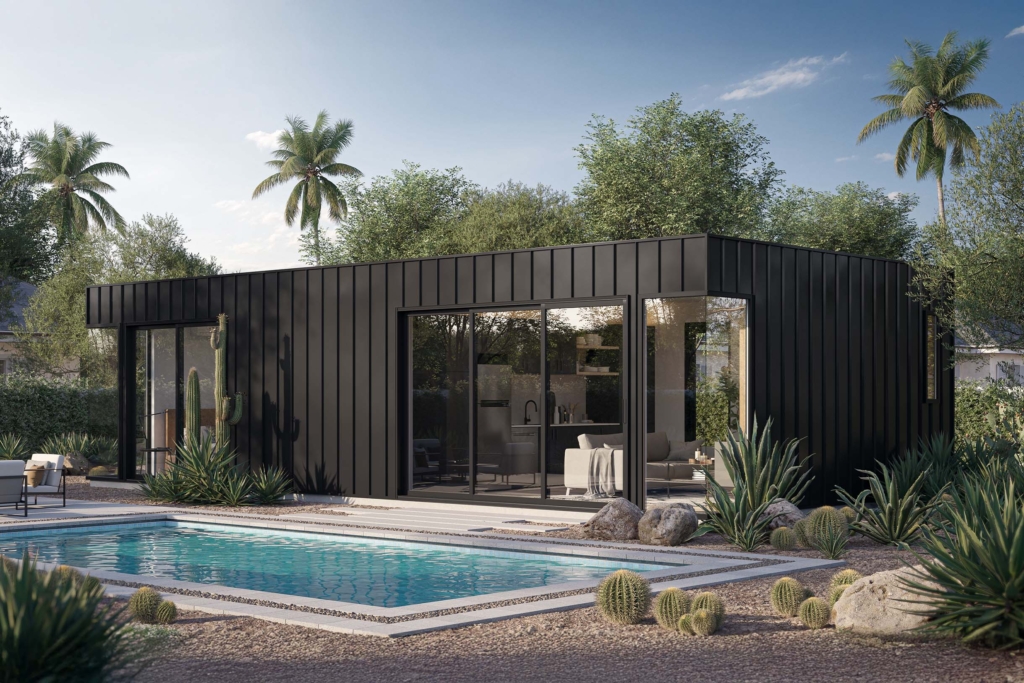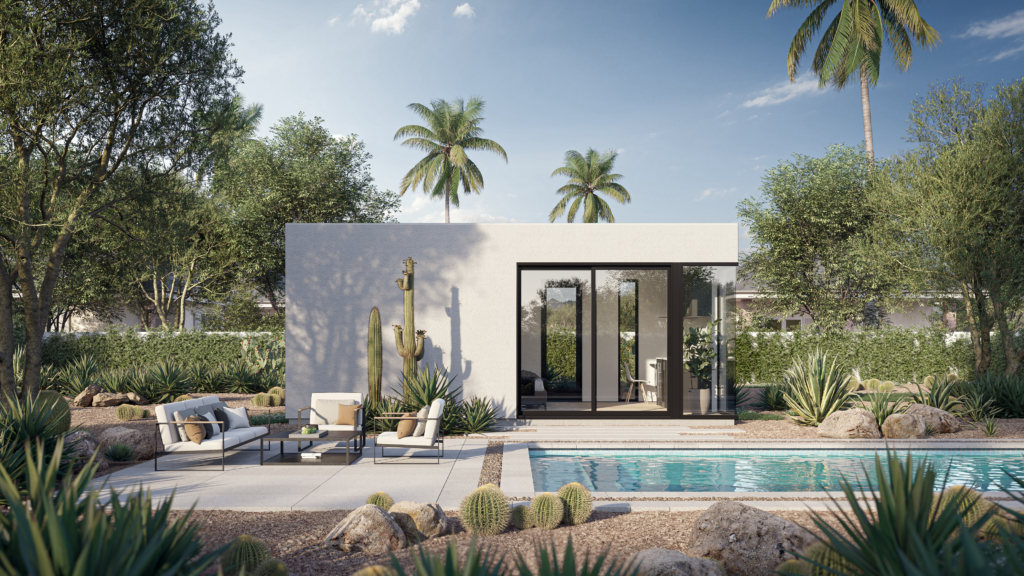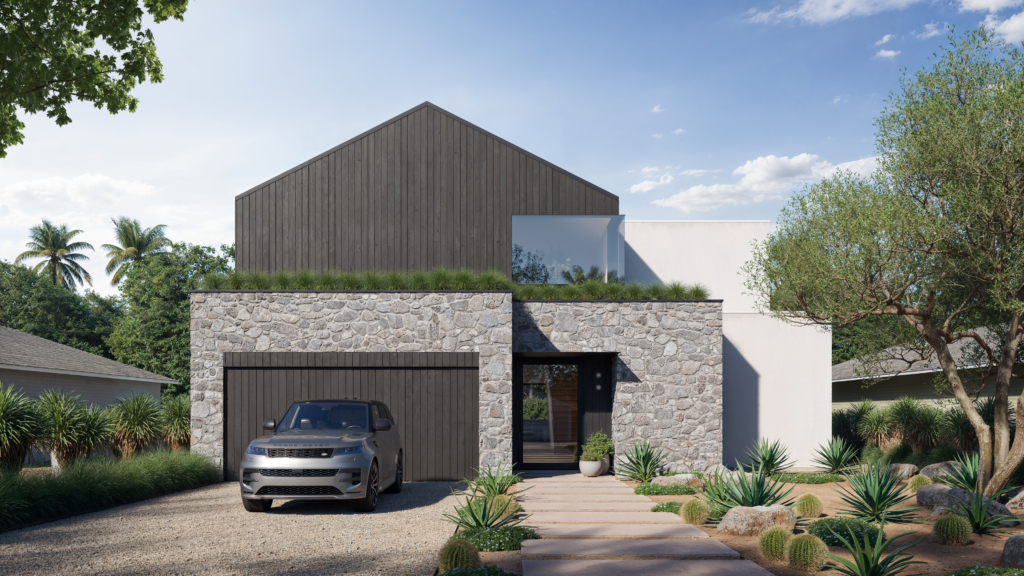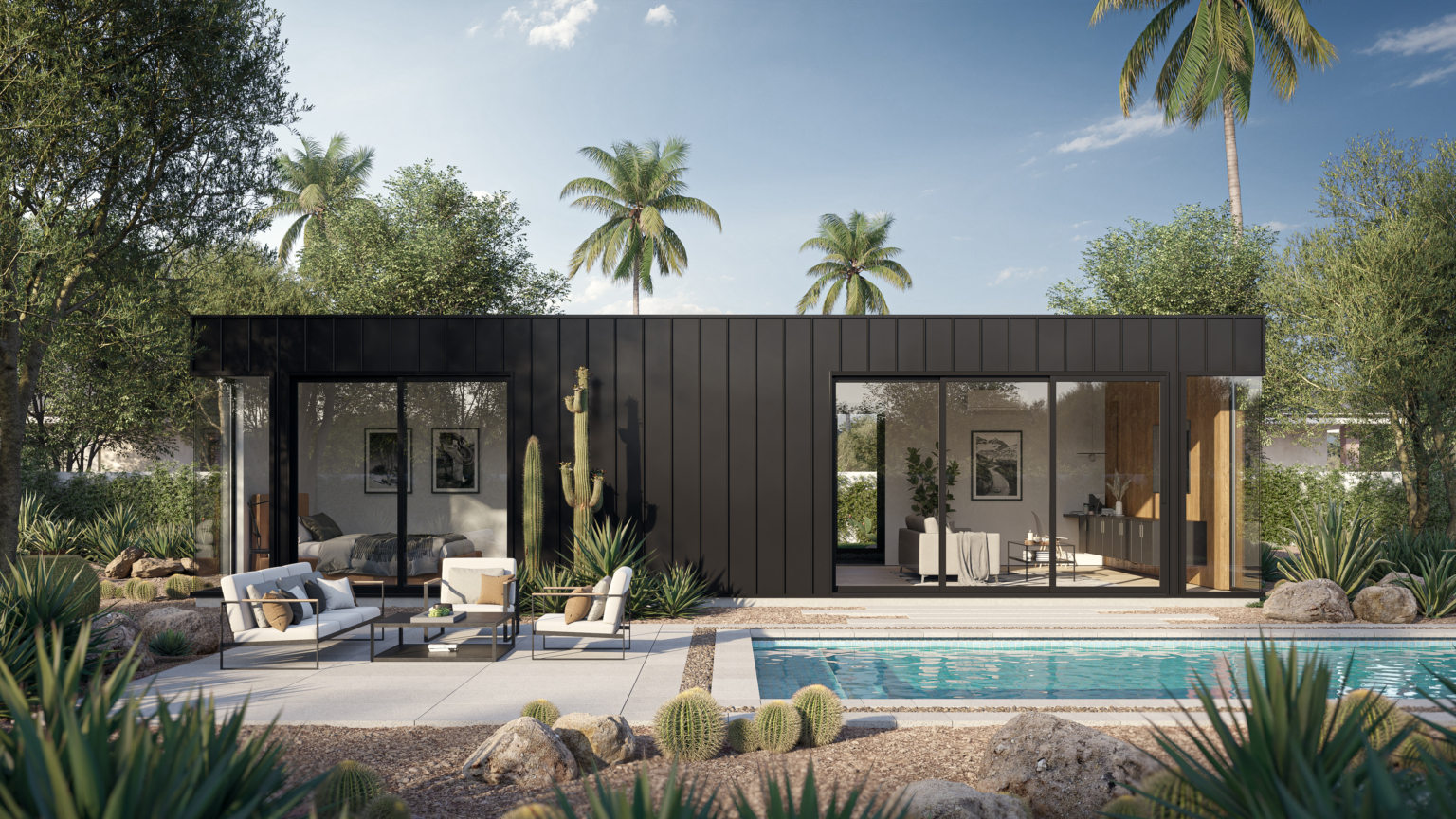
Prebuilt homes arrive on flatbed trucks with a promise that sounds dreamy as can be:
Your new living space, “factory-assembled and ready to install,” delivered like furniture from a catalog.
The appeal is obvious, between the speed and the apparent predictability.
Rooted into the ideal of the prebuilt home is the promise that construction happens somewhere else while you keep living your life.
Prebuilt units arrive looking nearly finished, lifted into place in a single dramatic day that makes modern housing feel almost frictionless.
But that moment is only the midpoint, not the conclusion.
What follows, from utility coordination to inspections, foundation alignment to delayed permits, and finish work that doesn’t always match the factory-perfect images, often stretches far longer than expected.
It’s a realization that’s caused us to think differently about ADUs and take a fresh approach rooted in the same care and attention you would give your main house.
The Draw of Speed
The prebuilt homes industry sells on the back of a single main idea: time.
Factory-built units promise weeks instead of months, and in some cases, that speed is real.
But in the ADU world, especially in Arizona, where climate and permitting bring some complexity to the process, the advantage isn’t quite as clear-cut as that.
Industry data often cites 30–50% faster build times, but those numbers focus on factory assembly, not the full timeline from design to move-in.
Once you factor in permits, site prep, utility connections, and post-install finish work, the gap narrows pretty fast.
That’s why the decision very often comes down to what your priorities are.
If speed alone matters, prebuilt can make sense.
If performance, customization, and long-term value matter to you as well, traditional construction (done efficiently) often ends up being the much better fit.
Why Arizona’s Climate Challenges Prebuilt Homes
Phoenix summers are unforgiving in ways that we at MLC just can’t imagine factory specifications could ever fully anticipate.
Our ADUs are very carefully designed specifically for desert conditions, with insulation packages, HVAC systems, and window treatments calibrated to temperatures that regularly exceed 110 degrees.
Prebuilt homes, manufactured for national distribution, use standardized specifications that work adequately in moderate climates.
But those same specifications tend to struggle in extremes.
The thermal envelope (how a structure manages heat transfer) is a fairly non-negotiable consideration in Arizona, as we’ve come to know very well over the years.
Naturally, this is something we account for as much as possible in our building processes, as we know it’s a consideration for a good reason.
Our Live model ADU, for example, includes enhanced insulation values, strategic window placement to minimize solar gain, and HVAC systems sized for extreme heat loads.
These specifications can help ensure comfort and efficiency in ways prebuilt alternatives can’t match without taking a host of very particular considerations, that vary from region to region across the state, into consideration.
Building a home, more often than not and especially in Arizona, is always going to be a negotiation of the land and its climate.
One client who had initially considered a prebuilt home before choosing our Dwell two-bedroom put it this way:
A modular company showed her energy estimates based on “typical” usage.
But she knew that Phoenix in July isn’t typical, and she needed a home designed for 115-degree days, for the out-of-the-blue extremes, not for theoretical averages.
Design Limitations in Prebuilt Homes
Prebuilt homes get their efficiency from standardization.
Factories excel at doing the same thing over and over: dialing in a small set of models, optimizing the process, and producing them at scale.
That works beautifully if your needs line up with what’s already been designed.
But the moment your site, your taste, or the way you actually live falls outside those templates, the factory model can start to feel restrictive fast.
Our Live+ model at 675 square feet is in the sweet spot we’ve found through hundreds of ADU projects, large enough for genuine living or working space, small enough to fit most urban lots, and flexible enough to accommodate diverse uses.
We’ve customized designs for specific properties, adjusted layouts to respond to real site conditions, and modified finishes to complement existing architecture.
That flexibility comes from building on-site, where we can adapt as circumstances reveal themselves.
Ground conditions shift, existing structures surprise us, and light or views feel different when you’re standing in the framed space.
And traditional construction allows us to adjust intelligently in real time.
A footing can deepen, a window can move, a service run can reroute, a detail can refine itself in the hands of a skilled craftsperson.
It’s not about improvisation for its own sake; it’s about giving the building room to evolve in dialogue with its site, materials, and the people shaping it.
Factory construction, by contrast, places limits on customization.
Want to adjust window placement to match how the sun actually moves across your lot?
That’s possibly going to be quite difficult.
Need to shift interior walls to suit how you plan to live in the space?
That’s sometimes just not possible.
The list goes on.
Put simply, prefab homes rely on repetition for efficiency, and repetition doesn’t leave much room for the site-specific decisions that make an ADU feel integrated and intentional, rather than simply placed on a lot as an afterthought.
A couple in Arcadia wanted their ADU to complement their 1950s ranch home’s mid-century aesthetic, and the modular companies they consulted offered contemporary designs that would have looked imported from another era.
Our traditional construction approach allowed us more flexibility and adaptability, enough to match materials, replicate rooflines, and create an ADU that felt like it had always belonged there.

Quality Control and Long-Term Performance
Prefab builders often cite factory conditions as a quality advantage due to a combination of factors. Our Minimal Living Concepts versus Boxabl comparison looks at that factory-versus-custom question from another angle:
Controlled environments, standardized processes, and fewer weather variables are common on the list.
And in theory, that should lead to more consistent results, but as practice has informed us, quality varies widely between manufacturers.
And most homeowners have no clear way to verify those claims ahead of time.
Our approach is to build ADUs on-site, in Phoenix’s real conditions, with city inspectors reviewing the work at every stage.
That’s our way of ensuring there’s built-in accountability, and when issues do arise, on-site building allows us to address them immediately, rather than discovering problems after delivery.
When it’s too late in the game, fixes become complicated and expensive, and we don’t want that.
Traditional construction also produces structures designed for decades of use in Arizona’s specific climate.
Prebuilt homes, manufactured for broad distribution, often rely on materials and methods suited to milder regions that struggle under sustained desert exposure.
We’ve seen modular units develop stress cracks within a couple of years, HVAC systems undersized for peak summer loads, and exterior finishes degrade under intense UV.
And these are all issues local builders anticipate and prevent because they build for this environment every day.
The ADU Advantage: Purpose-Built for Backyards
The term “prebuilt homes” encompasses everything from tiny houses on wheels to multi-million-dollar luxury modules.
But for Arizona ADU applications, traditional construction adapted for efficiency offers distinct advantages that factory methods struggle to match.
Every lot is different, especially in terms of slope, drainage, sun exposure, and utility access.
On-site construction responds to those realities as they appear, while prefab reverses that equation, forcing the site to adapt to the module instead.
That often means more site prep, more complexity in the long run, and costs land up racking up higher and higher as a result.
Expenses can be saved, but in cutting certain corners or negotiating these things in hindsight, you can also land up spending far more than anticipated.
Here are a few other core considerations:
- Utility integration: ADUs need seamless connection to existing infrastructure, and traditional construction handles this integration during the build process.
Modular units arrive complete but they come disconnected too, creating interface challenges that licensed contractors must resolve. - Aesthetic coherence: Backyard structures should enhance property value, not diminish it.
Traditional construction matches existing architecture organically, while prebuilt homes, designed for anywhere, often look like they belong nowhere in particular. - Regulatory navigation: Arizona’s current ADU law under House Bill 2720 have evolved significantly, but municipalities still approach permitting differently.
We’ve navigated these processes hundreds of times.
And the tough truth is that factory builders, particularly those based elsewhere, often lack this local expertise, leading to permitting delays that eliminate any speed advantage their construction methods promised.

Economics Beyond Initial Cost
The financial case for ADUs goes beyond upfront construction costs, as they have a lot of long-term value and can improve rental performance in no small way.
Freddie Mac notes that adding an ADU may increase a home’s long-term value and create rental income.
But that value only holds if the ADU functions as real housing, comfortable, durable, and finished to a standard renters recognize.
Prebuilt homes that struggle in Arizona’s climate, require frequent maintenance, or feel obviously temporary can undermine that return.
Potential rental income varies by neighborhood, unit size, finishes, utilities, and lease terms. Use current nearby comparables before underwriting an ADU.
Units that feel cheap, underperform in the heat, or show early wear tend to rent for less, or else they sit vacant longer.
One investor client summed it up after comparing three of his rentals: two with our on-site–built ADUs, and one with a prebuilt unit.
The traditionally built ADUs rented immediately at market rates.
The modular unit required price cuts and still took longer to lease.
On paper, he told us, the numbers looked similar.
But the moment people walked through the space, they could feel the difference.
The Timeline Reality Check
And now, we can address the prefab industry’s main selling point head-on: speed.
Yes, factory construction moves quickly.
But when you look at the full timeline, from initial consultation to move-in, that advantage shrinks considerably once every phase is accounted for.
Our typical ADU project runs eight months from contract to completion, and this includes:
- Design finalization and permitting: 2-3 months
- Site preparation and foundation: 1 month
- Construction: 3-4 months
- Final inspections and closeout: 2-3 weeks
A prebuilt home timeline looks like:
- Design selection (limited options): 1-2 weeks
- Factory production: 2-3 months
- Site preparation and foundation: 1 month
- Delivery and installation: 1-2 weeks
- Utility connections and finishing: 1-2 months
- Permitting and inspections: 1-2 months
The total difference often amounts to 4-8 weeks, put simply. Our Phoenix ADU permit guide shows why municipal review time still belongs in either schedule.
That’s meaningful, for sure, but it’s not exactly revolutionary, and that’s assuming the modular process proceeds without complications, which experience suggests is optimistic.
Really, the time difference is negligible when you consider what you want out of the building process alongside it.

When Prebuilt Homes Make Sense
To be fair, factory-built homes do make sense in certain situations.
Emergency housing after a natural disaster, for example, prioritizes speed above all else.
Remote sites where traditional construction is logistically difficult can also benefit from factory production.
And for genuinely temporary housing, where long-term durability isn’t the goal, simpler construction can be a reasonable tradeoff.
But for most Phoenix homeowners considering an ADU, whether for multigenerational living, home office space, rental income, or creative studios, traditional construction adapted for efficiency delivers better long-term value.
The modest time savings prebuilt homes offer rarely justify the compromises in customization, climate optimization, aesthetic integration, and long-term performance.
Moving Forward
If you’re weighing prefab versus traditional construction for an ADU, we’re happy to talk through what actually matters for your situation.
Some clients come in convinced they want modular and leave seeing why on-site building fits better, while others realize prefab truly aligns with their goals.
But all in all, performance in Arizona heat, fit on the lot, daily comfort, and long-term value matter far more than construction buzzwords.
For homeowners making long-term investments, on-site construction, done efficiently and designed for the desert, continues to deliver ADUs that feel better, age better, and integrate better, even if they take a little longer to build.