Recently, I’ve been thinking about the conversations we have with Phoenix homeowners – the ones that start with square footage but quickly become about something deeper.
A daughter wondering how to keep her aging mother close without sacrificing independence. A couple wondering whether they’ll have enough space in their home once the kids grow. A professional staring at their kitchen table-turned-office, wondering if working from home means never really leaving work.
These are life problems that happen to have architectural solutions.
The word “casita” means “little house” in Spanish, but that barely scratches the surface.
This centuries-old Southwestern tradition – guest quarters on haciendas, homes for extended family, spaces that kept people close while giving them room to breathe – has become one of the most compelling answers to challenges Phoenix families face right now.
That tension between proximity and privacy, between family obligation and personal autonomy is as relevant today as it was two hundred years ago.
Now casitas are solving modern versions of timeless challenges: multigenerational living without the $6,000 monthly assisted living bill, rental income without distant landlording, home offices that actually separate work from life. Our Arizona case study shows how casitas support multigenerational living in practice.
Here’s what makes a casita different from just another backyard structure, and why this regional tradition might be exactly what your property needs.
The Historical Context
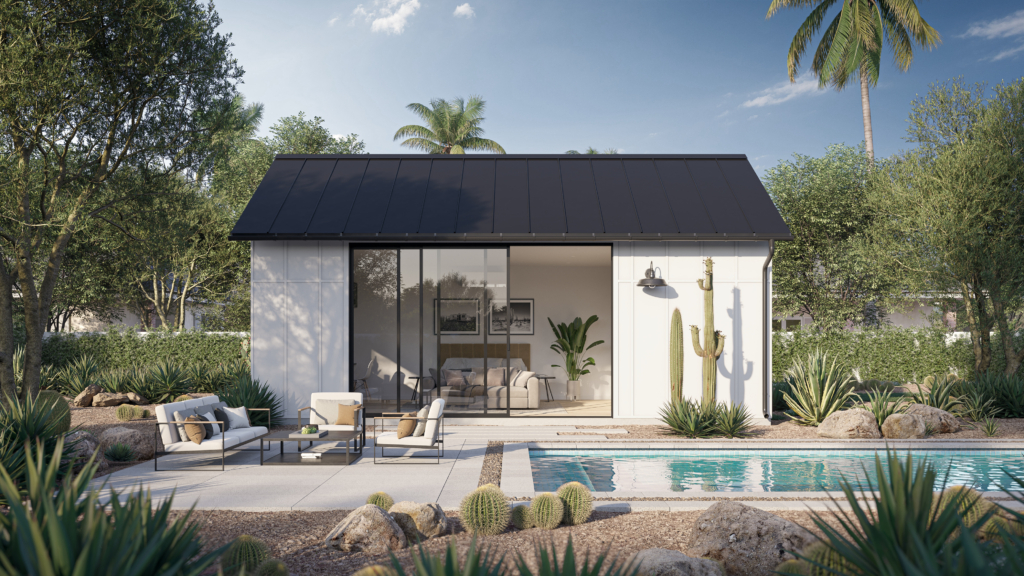
To understand what a casita is, we have to first reach back into Spanish colonial architecture and Mexican building traditions that shaped the American Southwest long before modern zoning codes existed.
Traditional casitas in Mexican haciendas served as guest quarters, servants’ housing, or accommodations for extended family.
They were separate structures.
And they made it possible to maintain connection to the main residence while preserving independence.
These weren’t afterthoughts but intentional architectural elements reflecting cultural values around family, hospitality, and multigenerational living.
Its architectural characteristics include thick adobe or stucco walls providing thermal mass, small windows minimizing heat gain, and covered porches creating transitional outdoor spaces.
And each one emerged from practical responses to desert climate rather than aesthetic preference.
Form followed function in the most fundamental sense.
Centuries of trial and error produced solutions elegantly adapted to Southwestern conditions.
Casita vs. ADU vs. Guest House
The terminology around auxiliary residential structures can feel confusing.
What distinguishes these terms, and does it actually matter?
ADU (Accessory Dwelling Unit) is the formal planning terminology, the legal classification municipalities use in codes.
House Bill 2720, Arizona’s current statewide ADU law, sets minimum municipal requirements for ADUs, the regulatory category for self-contained secondary dwellings on the same lot as a larger single-family home.
Guest house suggests primary function rather than style.
Guest houses emphasize temporary occupancy, ideal for visiting family, extended stays, short-term rentals.
They may lack full kitchens, often feature less storage, and incorporate design supporting transient rather than permanent living.
And what is a casita?
A casita holds cultural and regional specificity.
The term signals something beyond functionality.
It suggests place-specific architectural identity rooted in centuries of desert living.
While functionally similar to ADUs, the term evokes Southwestern architectural character and Spanish colonial heritage.
You wouldn’t call a Cape Cod cottage in Massachusetts a casita, for instance.
The term implies regional architectural identity.
Our approach to casita and guest home design recognizes these cultural dimensions while incorporating contemporary building systems and modern expectations.
Architectural Characteristics
Several elements consistently appear in successful casitas, distinguishing them from generic structures.
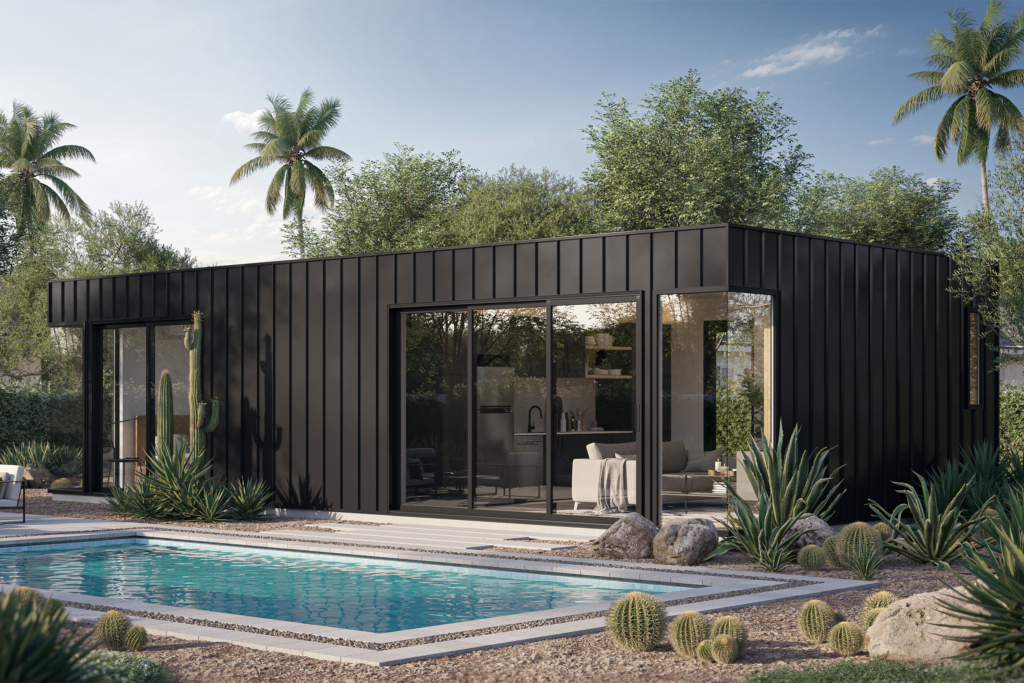
- Low-profile forms characterize traditional casitas, single-story structures with horizontal emphasis.
This responds partly to desert heat management (less volume to cool) and partly to aesthetic integration with landscape.
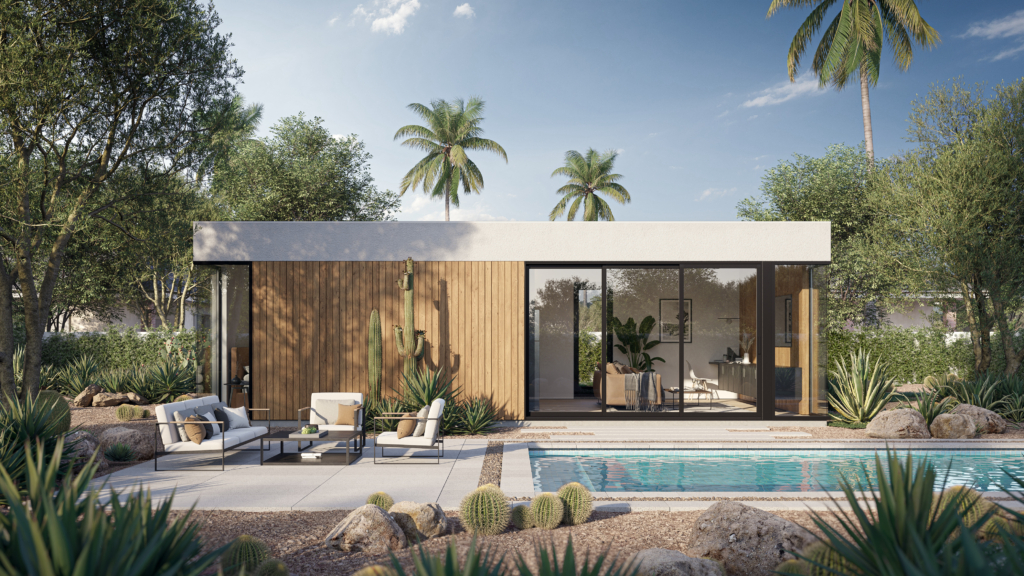
In our minds, a casita should nestle into property rather than dominate it. - Stucco exteriors provide both aesthetic consistency with Southwestern traditions and practical benefits.
They offer excellent thermal mass, durability, and relatively low maintenance.
The textured, monochromatic surfaces complement desert landscapes in ways vinyl siding simply cannot. - Tile or flat roofs with low pitches reflect both historical precedent and climate adaptation.
Clay tile provides excellent insulation, remarkable longevity, and unmistakable regional character.
Flat roofs with parapet walls create clean lines while accommodating solar installations increasingly common in Phoenix.
And according to plenty of research, proper roof design significantly impacts cooling loads in hot climates. - Covered outdoor spaces (portales, ramadas, covered patios) can help extend living area while also providing crucial shade and transitional zones.
These aren’t purely decorative; they can also be functional necessities where outdoor temperatures regularly exceed 110°F, but evenings cool comfortably. - Courtyard relationships between the casita and the main house create semi-private outdoor areas serving both structures, recreating in miniature the courtyard-centered planning of traditional haciendas.
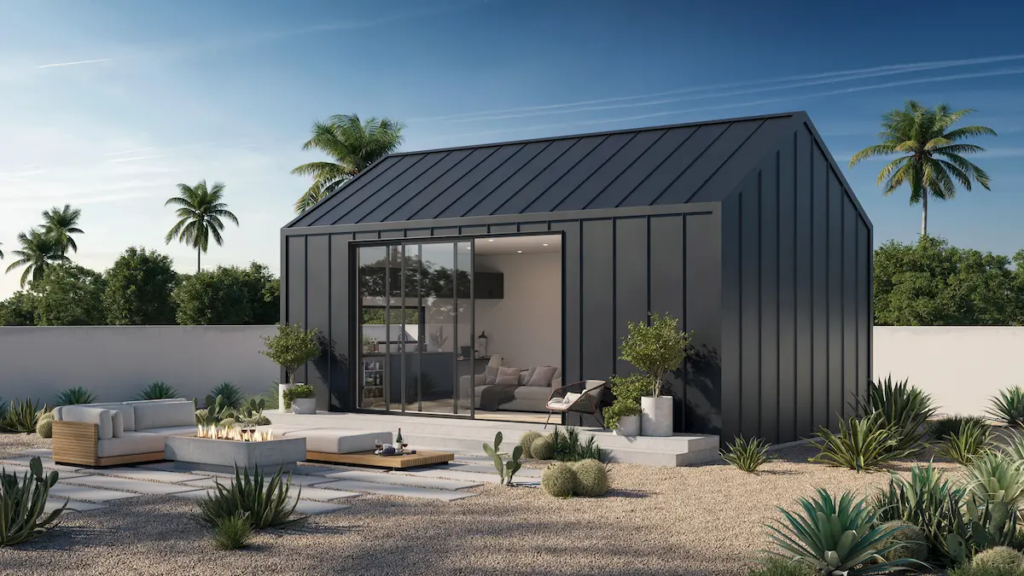
Our M1, M2, and M3 designs incorporate these traditional characteristics intentionally, all while meeting contemporary codes and energy standards.
Climate Responsiveness
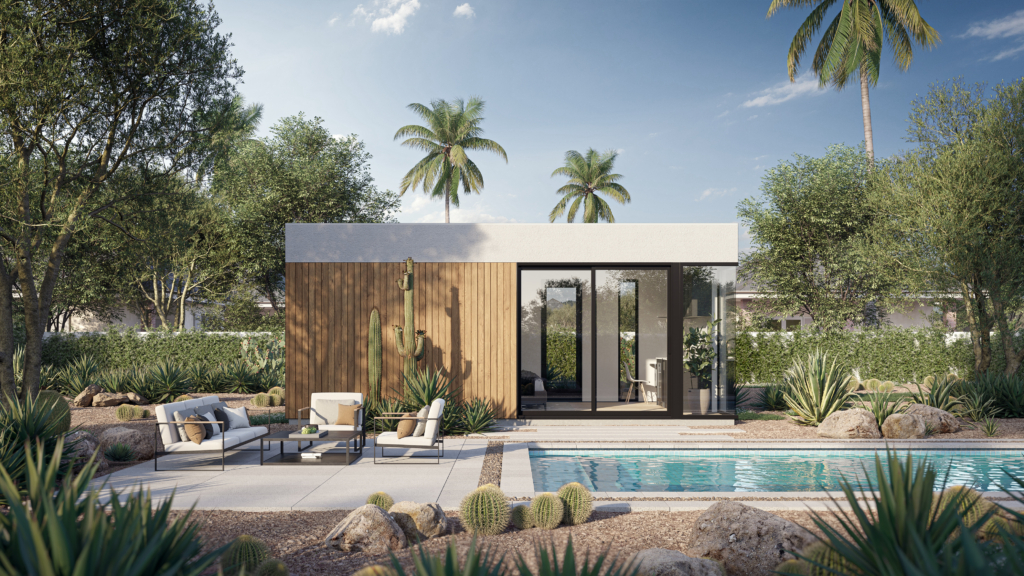
The casita architectural form succeeds in Southwestern contexts because it evolved specifically for desert conditions.
In many ways, they’re adaptable to the very conditions that make Phoenix what it is.
Here’s how:
- Thermal mass strategies inherent in traditional construction (thick stucco walls, concrete floors, minimal west-facing windows) moderate interior temperatures through thermal lag.
Materials absorb heat slowly during day, release it gradually at night when outdoor temperatures drop.
This passive cooling significantly reduces mechanical cooling loads.
Modern casitas incorporate these principles through enhanced insulation, high-performance windows, and strategic thermal mass while adding contemporary HVAC systems.
The result combines traditional climate wisdom with modern comfort.
- Solar orientation, glazing faces south or east, and capturing pleasant morning light while minimizing brutal western exposure.
These orienting decisions can have a major impact energy costs, and proper solar orientation can reduce cooling loads by 20-30% in Phoenix’s climate. - Natural ventilation potential through cross-ventilation allows casitas to operate without mechanical cooling during shoulder seasons.
The Phoenix climate offers more natural ventilation opportunities than people realize, with roughly six months feature comfortable enough conditions for passive cooling. - Landscape integration (native plants providing shade, desert landscaping minimizing water consumption) extends climate responsiveness beyond the structure itself.
Functional Versatility
The enduring appeal of casitas reflects their remarkable functional adaptability. We set out the full list in our piece on why Arizona homeowners build an ADU.
And among them, multigenerational living is, at least in our view here at MLC, the most common contemporary application.
Aging parents maintain independence while remaining close to family.
Adult children establishing careers access affordable housing near family networks.
We have already explored some of this in our comparison of ADUs versus assisted living facilities, where financial and quality-of-life advantages prove substantial.
It’s worth keeping in mind that assisted living in Phoenix averages $4,500-$6,500 monthly, according to the Genworth’s Cost of Care Survey.
Then, there’s rental income generation, which is how casitas can become investment vehicles.
A 400-600 square foot casita commands $900-$1,400 monthly according to current rental data, producing returns often exceeding traditional investments.
We detailed this in our analysis of casitas for rental investors.
And then, there are home offices, which accelerated during pandemic remote work shifts.
Professionals need dedicated workspace separated from household activity.
And quite naturally, a casita provides this perfectly, with professional environment for meetings, no commute, and complete flexibility around family schedules.
Creative studios benefit from the separation casitas provide.
The noise, mess, or irregular hours of creative work often conflict with conventional household rhythms.
There’s also the flexibility to shift between uses, as the casita serves as guest quarters initially, transitions to rental unit, and converts to aging parent housing.
That’s the adaptability that fixed-function spaces cannot match.
Design Considerations
Creating casitas that function beautifully requires attention to distinguishing thoughtful design from generic execution. The same site-specific decisions are covered in our guide to ADU plans for Arizona properties.
Scale appropriateness matters enormously.
In our opinion, a casita should feel proportionally related to the main house without mimicking it.
Our Flex studio design at 322 square feet works on modest lots, while the Dwell two-bedroom at 1,178 square feet suits larger properties. You can compare our casita floor plans by size and starting price.
Then, there’s privacy calibration, which requires balancing connection with separation:
- Window placement avoiding direct sight lines.
- Entry sequences providing transitional space.
- Outdoor spaces oriented for privacy from both main house and neighbors.
And believe it or not, kitchen configuration significantly affects functionality and costs. We put numbers to that in our piece on what an ADU kitchen actually costs.
Full kitchens enable genuine independent living but add $10,000-$18,000.
Kitchenettes provide basic capabilities while controlling costs.
Our Live one-bedroom design, for instance, incorporates full kitchen facilities that don’t feel compromised.
And storage adequacy is far more critical than many may think
Built-in storage, vertical space use, and multi-functional furniture need integration during design.
Interestingly, there’s research on residential satisfaction that identifies storage adequacy as among the strongest predictors of occupant happiness.
The Construction Reality
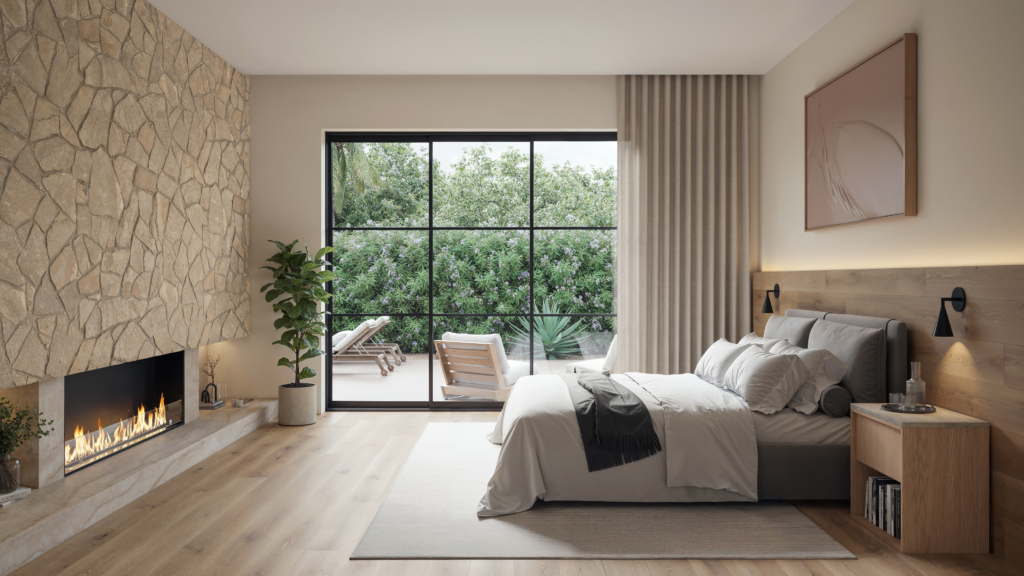
Building a casita follows relatively predictable timelines when approached systematically.
And at MLC, we’re pretty committed to traditional construction methods.
Why?
Put simply, this devotion comes from practical experience.
Site-built casitas respond to specific property conditions (existing architecture, solar orientation, landscape features) in ways prefab cannot match.
Banks finance traditionally-constructed casitas as permanent improvements without complications that modular units introduce.
The permit approval process typically requires 4-8 weeks in Phoenix-area municipalities, and construction timelines span roughly 6-8 months for casitas in the 400-800 square foot range.
The complete timeline, from initial consultation through occupancy, typically spans 8-10 months.
Making the Decision
So, what is a casita?
The possibilities, according to us here at MLC, are pretty much endless.
Ultimately, whether this architectural solution aligns with your property and circumstances is totally up to you.
But we can help you decide, of course.
Getting your quote begins with understanding your goals and site conditions.
You may also value our pricing structure, which can offer transparent accounting of costs and returns.
The casita is an architectural tradition simultaneously ancient and contemporary, culturally specific and broadly applicable, financially pragmatic and lifestyle-enhancing.
Your property may hold potential for this particularly Southwestern solution to universal housing challenges.
And if you’re at all curious, reach out to us, and we’d love to help you determine what’s right for your needs.