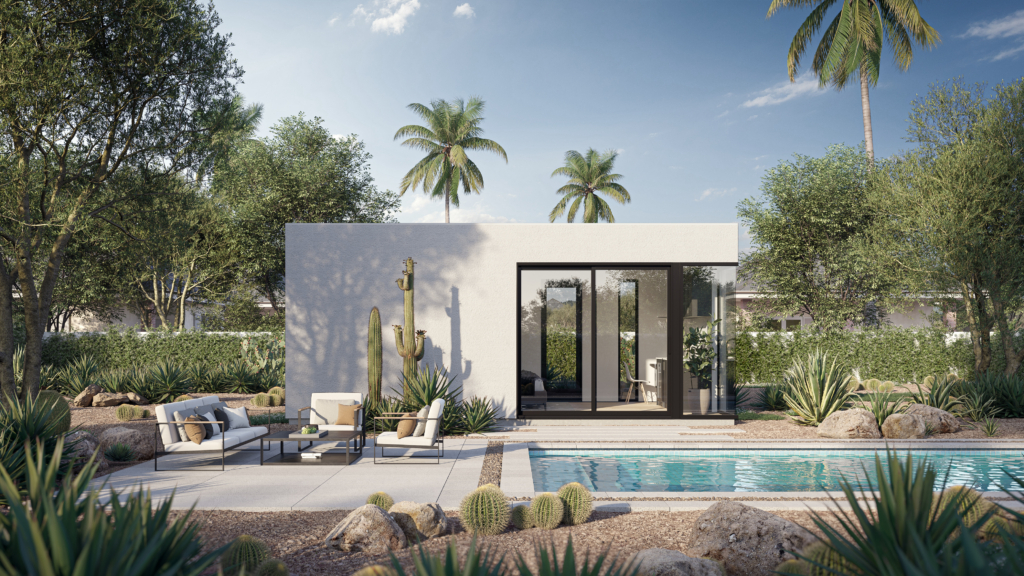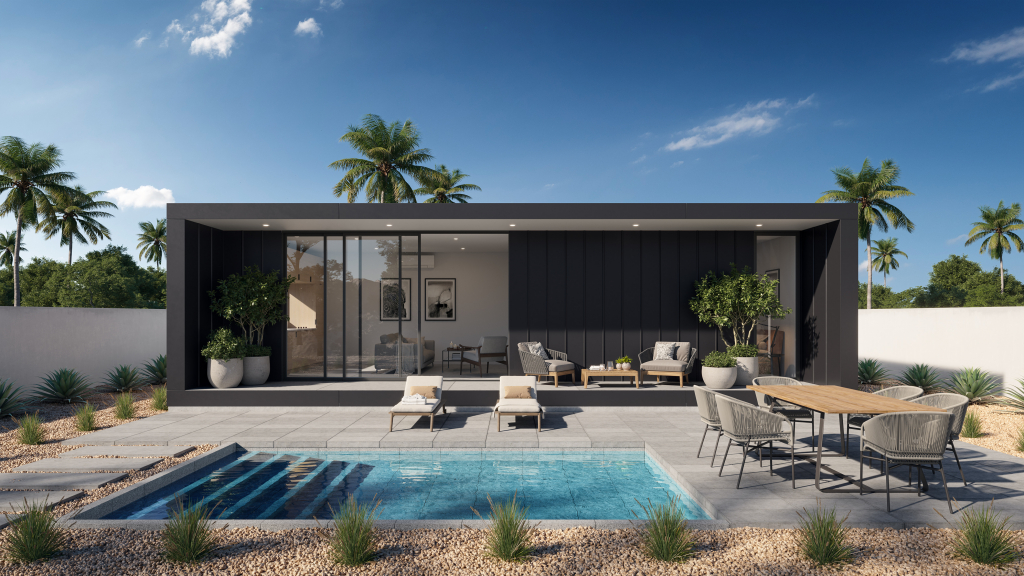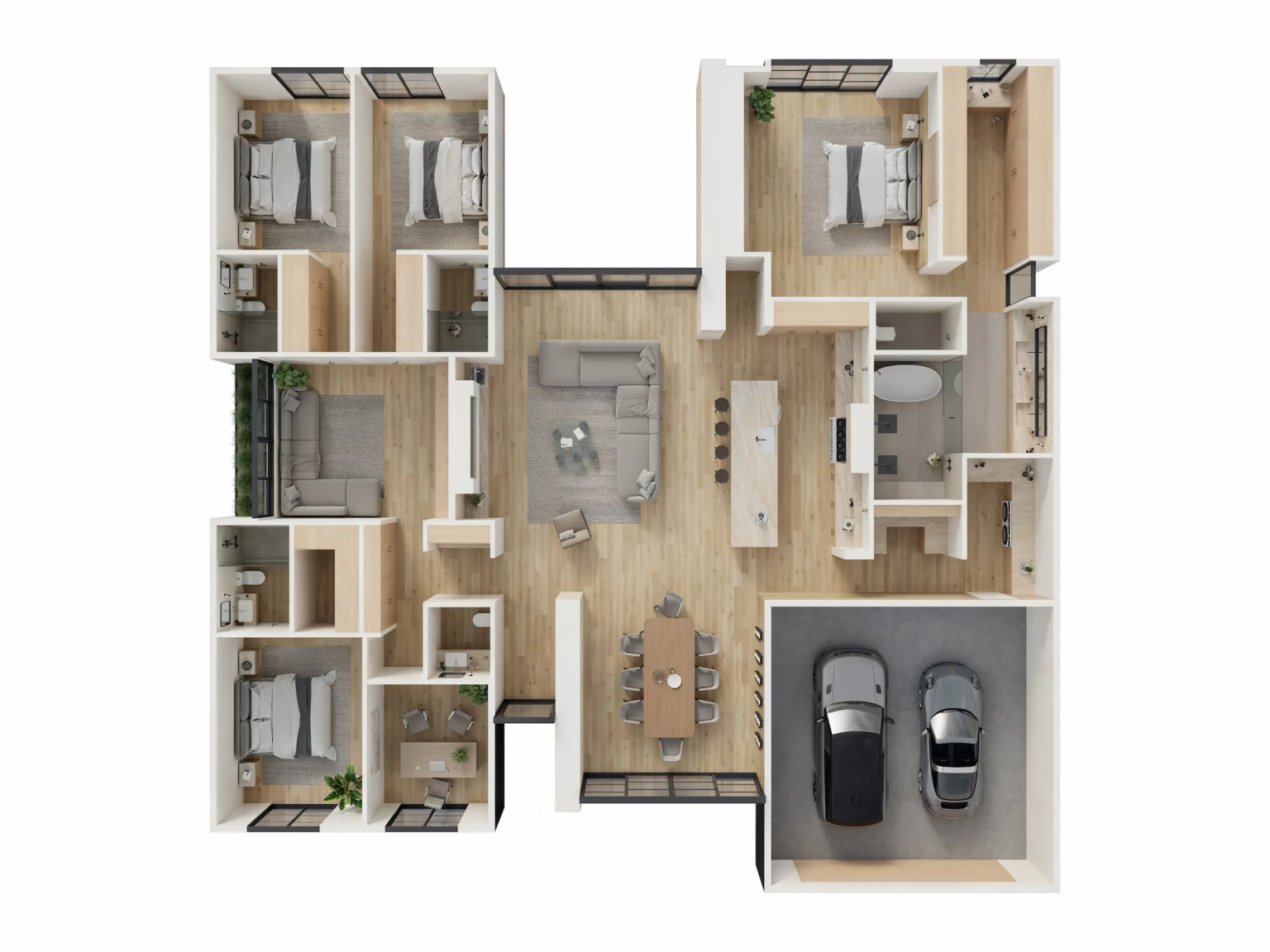
Tiny home plans, especially the ones downloaded from popular websites, so rarely account for Phoenix’s 115-degree summers, and I see this problem repeatedly with new clients.
The floor plan spread across my desk last week showed 380 square feet configured with surgical precision:
Dining table folding into the wall, stairs concealing storage drawers, sleeping loft tucked beneath a peaked roof.
Honestly, something felt immediately off.
And then I put my finger on the fact that this tiny home plan had been designed for Portland’s mild climate.
In Phoenix’s extreme heat, that loft would become borderline, if not wholly, uninhabitable.
Most tiny home plans circulating online assume moderate climates and lifestyle patterns that don’t match Arizona’s unique demands.
So at MLC, we run on the belief that creating successful tiny homes in the desert requires fundamentally reimagining how these compact spaces function.
But once the tiny home is adapted for our full-throttle heat, there’s a lot to love.
Even if you don’t think of yourself as a tiny house person right off the bat, you may want to give this article a glance.
In today’s post, we’ll speak realistically to all a tiny home can contain and how to make it a welcoming sanctuary, even in the hot sun.
Why Generic Plans Don’t Fit Arizona
Tiny home plans proliferate across the internet, promising dream homes in miniature footprints.
There’s been a buzz around them for years now.
Now, there are well over 10,000 tiny houses nationwide, with thousands more in planning stages.
Yet, most available floor plans originate from regions with vastly different environmental demands than Arizona faces.
Consider thermal dynamics alone.
The International Energy Conservation Code establishes different climate zones requiring distinct building approaches.
Phoenix sits in Zone 2B (hot and dry), while Portland occupies Zone 4C (mild and marine).
A tiny home plan optimized for Portland’s gentle summers creates misery in Arizona’s extreme heat.
Sleeping lofts that work beautifully in moderate climates become uninhabitable when exterior temperatures exceed 110 degrees and heat rises into confined spaces.
One couple told us they spent their first summer in a pre-designed tiny home sleeping on the main floor because the loft was “like a sauna at midnight.”
That phrase really stuck in my mind. It sounds awful.
This mismatch is why understanding how much it costs to build a house is so essential even for tiny homes.
Adapting generic plans to Arizona’s climate often requires such extensive modifications that custom design becomes more economical.
Space Efficiency Meets Desert Living

Successful Arizona tiny home plans balance competing demands, maximizing limited square footage while managing extreme temperatures, providing privacy within open concepts, and creating homes that feel spacious despite compact dimensions.
Traditional tiny home plans often emphasize vertical space utilization through sleeping lofts accessed by ladders or narrow stairs.
While this strategy works in moderate climates, Arizona’s heat stratification makes upper levels uncomfortable for much of the year.
Temperature differentials of 15-20 degrees can crop up between floor and ceiling levels in poorly designed spaces.
That’s why, in our minds, the best Arizona tiny home plans instead emphasize single-level living or incorporate mechanical ventilation ensuring loft comfort.
And unsurprisingly, the kitchen-living relationship proves particularly crucial in tiny home plans.
Open concepts maximize spatial perception, but cooking heat becomes problematic in already-challenging climates.
We position kitchens along north walls with operable windows for cross-ventilation, an approach reflecting principles from the art of luxury home renovations.
There’s also storage integration to consider, which distinguishes livable tiny home plans from those that photograph well but function poorly.
Arizona’s outdoor lifestyle demands space for hiking gear, camping equipment, and seasonal items.
Built-in storage using every vertical surface, under-stair cavities, and raised floor platforms provides necessary capacity without cluttering limited floor space.
The National Association of Professional Organizers recommends planning 10-15% of tiny home square footage for storage.
That’s significantly more than traditional homes require proportionally.
Site Orientation: The Often-Forgotten Factor
Most downloadable tiny home plans assume ideal site conditions.
They anticipate a perfect setup with level ground, unrestricted solar orientation, and standard utility connections.
Arizona’s diverse topography and intense solar exposure make site-specific adaptation essential.
A floor plan that works perfectly facing north might become uninhabitable when rotated ninety degrees.
And solar orientation dramatically impacts tiny home comfort and efficiency.
The U.S. Department of Housing and Urban Development recommends minimizing western exposure in hot climates, yet many tiny home plans position large windows symmetrically without considering orientation.
Tiny home floor plans that we’ve found work well in Arizona concentrate glazing on north facades for consistent indirect light. For ready-to-build examples, see our four casita floor plans in Arizona with sizes and starting prices.
These should also be limiting east and west openings to small, high windows that admit light without heat.
This orientation sensitivity explains why building a home in Arizona means thinking beyond the main house.
Tiny homes must integrate with existing structures, landscape features, and solar patterns.
A floor plan perfect in isolation might fail when positioned relative to property constraints.
Understanding how long it takes to build an ADU helps set expectations for custom tiny home plans.
And while pre-designed plans might seem faster, site-specific adaptations often negate time savings.
Custom plans developed alongside site evaluation typically require 6-8 weeks but prevent costly mid-construction modifications.
Creating Distinct Spaces Within Tiny Footprints
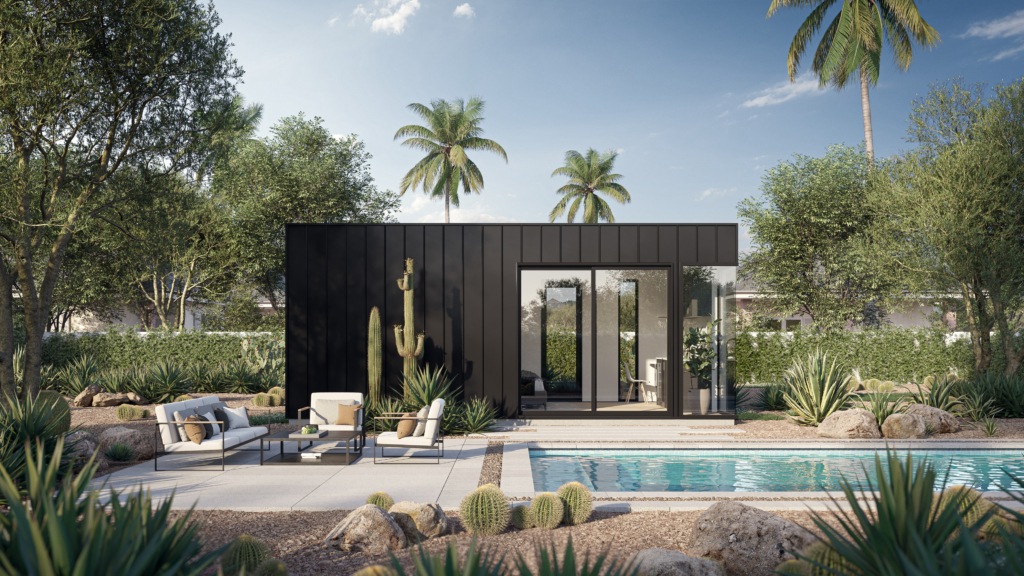
At MLC, we believe that the most inviting and effective tiny home plans consider how to build psychological spaciousness through careful zoning.
That’s true even within studios under 400 square feet.
How can this be done?
There are a few ways, but the most effective ones we’ve tried and tested include manipulating ceiling heights, floor levels, and visual barriers to define distinct areas without walls.
The Environmental Design Research Association identifies spatial variety as crucial for psychological comfort in compact living.
Consider a 350-square-foot floor plan we recently developed for a Tempe property.
Rather than one uniform space, varied ceiling heights create three distinct zones:
- Entry and kitchen: nine-foot ceilings for functionality
- Living area: nine feet with clerestory windows admitting light without sacrificing privacy
- Sleeping alcove: nine feet, creating intimacy while maintaining building code compliance
Floor level changes further define spaces without walls.
A raised sleeping platform provides under-bed storage while creating separation from living areas.
Two steps down might define a sunken conversation area.
Kitchen Configurations That Actually Work
The kitchen often determines tiny home livability, yet many floor plans treat it as an afterthought squeezed into leftover space.
A great Arizona tiny home plan will recognize kitchens as social centers and workspace priorities.
They really are the root from which the rest of the house extends!
So, they’re important to get right, especially in a more concentrated space.
Galley kitchens along single walls maximize efficiency in narrow tiny homes.
This linear arrangement places everything within arm’s reach while leaving circulation space clear.
U-shaped kitchens can also work well in wider floor plans, providing maximum counter space and storage.
Fortunately, your ADU kitchen renovation probably costs less than you think when approaching tiny homes strategically in this way.
Compact appliances designed for boats and RVs provide full functionality in minimal footprints, and induction cooktops eliminate gas line requirements while providing precise temperature control, while combination microwave-convection ovens replace traditional ranges.
There are ways to squeeze a lot out of a tiny space, maintaining its spaciousness and efficiency in one fell swoop, and without skyrocketing costs.
But you have to know a few hacks to get it right.
Bathroom Solutions for Minimal Spaces
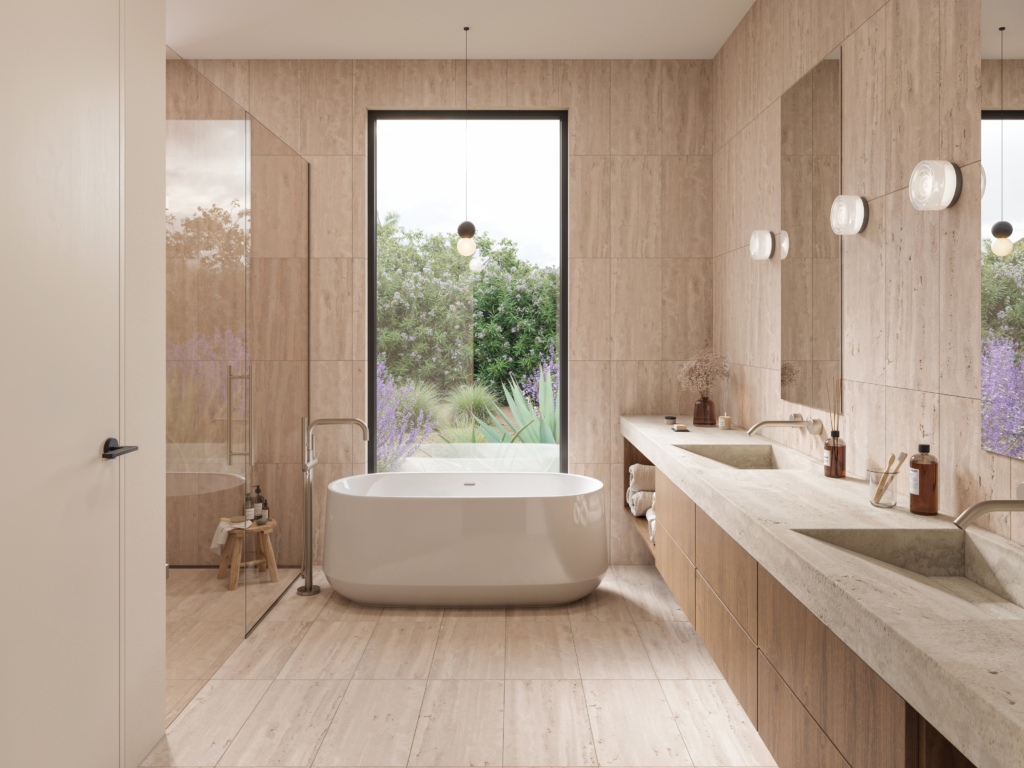
While this may be a little unexpected to some, bathroom placement significantly impacts tiny home plans, affecting plumbing runs, privacy, and traffic flow.
Wet baths borrowed from RV design combine toilet, sink, and shower in waterproofed rooms, maximizing space efficiency.
However, these require careful ventilation in Arizona’s humid monsoon seasons.
Separated bathrooms with distinct shower enclosures feel more residential but require additional square footage.
Corner sinks, wall-mounted toilets, and curbless showers optimize every inch while maintaining functionality.
Technology Infrastructure in Tiny Spaces
Modern tiny home plans must accommodate technology infrastructure often overlooked in traditional designs.
The Information Technology Industry Council reports that average households now contain 25 connected devices, requiring robust networking even in compact spaces.
Workspace for remote employment demands dedicated zones with appropriate lighting and acoustic separation.
Entertainment systems need sight lines and mounting surfaces.
And climate control systems require strategic placement for efficient air circulation.
A client recently shared that their tiny home office setup, which was so meticulously, carefully planned during the design phase, has been “completely seamless” for video calls and collaborative work.
It’s so satisfying knowing that kind of forethought really does make the difference between a functional tiny home and a frustrating one.
Modular Versus Custom Approaches
While modular homes are Phoenix’s smartest solution for many applications, tiny homes often benefit from site-specific customization.
The choice between pre-designed and custom tiny home plans depends on site conditions, budget constraints, and specific needs.
Pre-designed plans offer cost savings and proven layouts but may require extensive modification. See our casita floor plans for proven ADU layouts at each size.
Custom plans ensure perfect site integration and personalized features but require longer development periods.
Our process involves carefully evaluating which approach best serves each unique situation.
Making Your Tiny Home Plan Work
Successful tiny home living starts with floor plans that acknowledge reality rather than fantasy.
And in more straightforward terms, that means acknowledging that Arizona’s climate, topography, and lifestyle demand specialized approaches that generic plans rarely provide.
Whether adapting existing designs or creating custom solutions, the best way forward will always require understanding how every decision impacts comfort, functionality, and long-term satisfaction.
The tiny home movement offers genuine solutions to housing affordability and environmental concerns, but only when plans match place.
We’ve completed over 100 successful small-scale projects across greater Phoenix, and we understand how to maximize every square foot while ensuring comfort and functionality.
Getting your ADU quote is the first step toward understanding the cost of building an ADU in Phoenix and exploring the options within your budget.
Don’t hesitate to contact us to discuss how thoughtful planning creates tiny homes that live large.