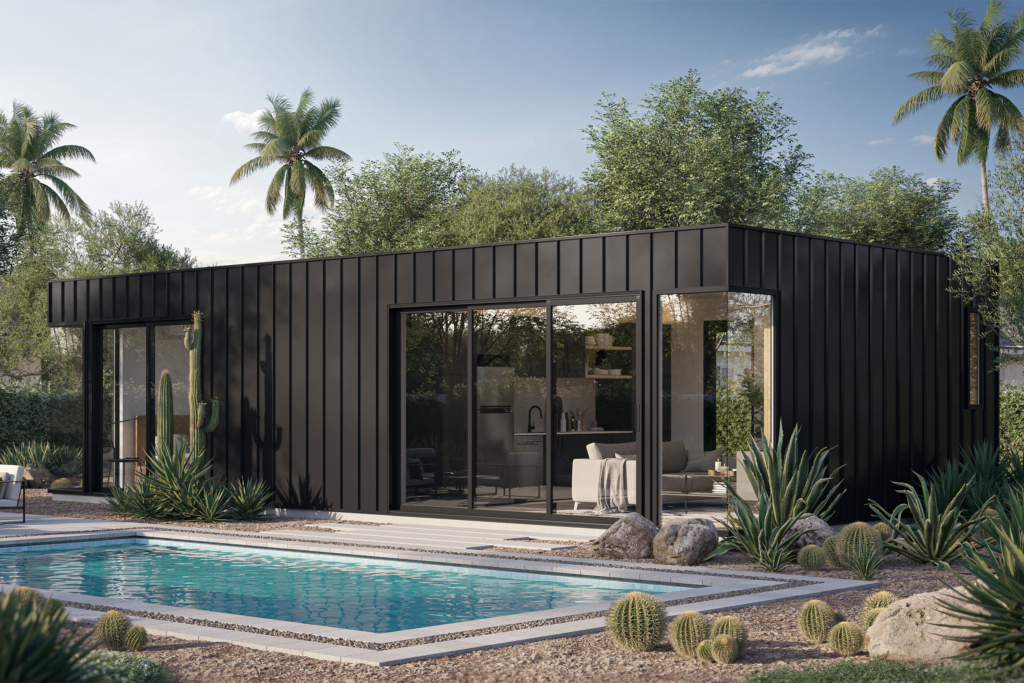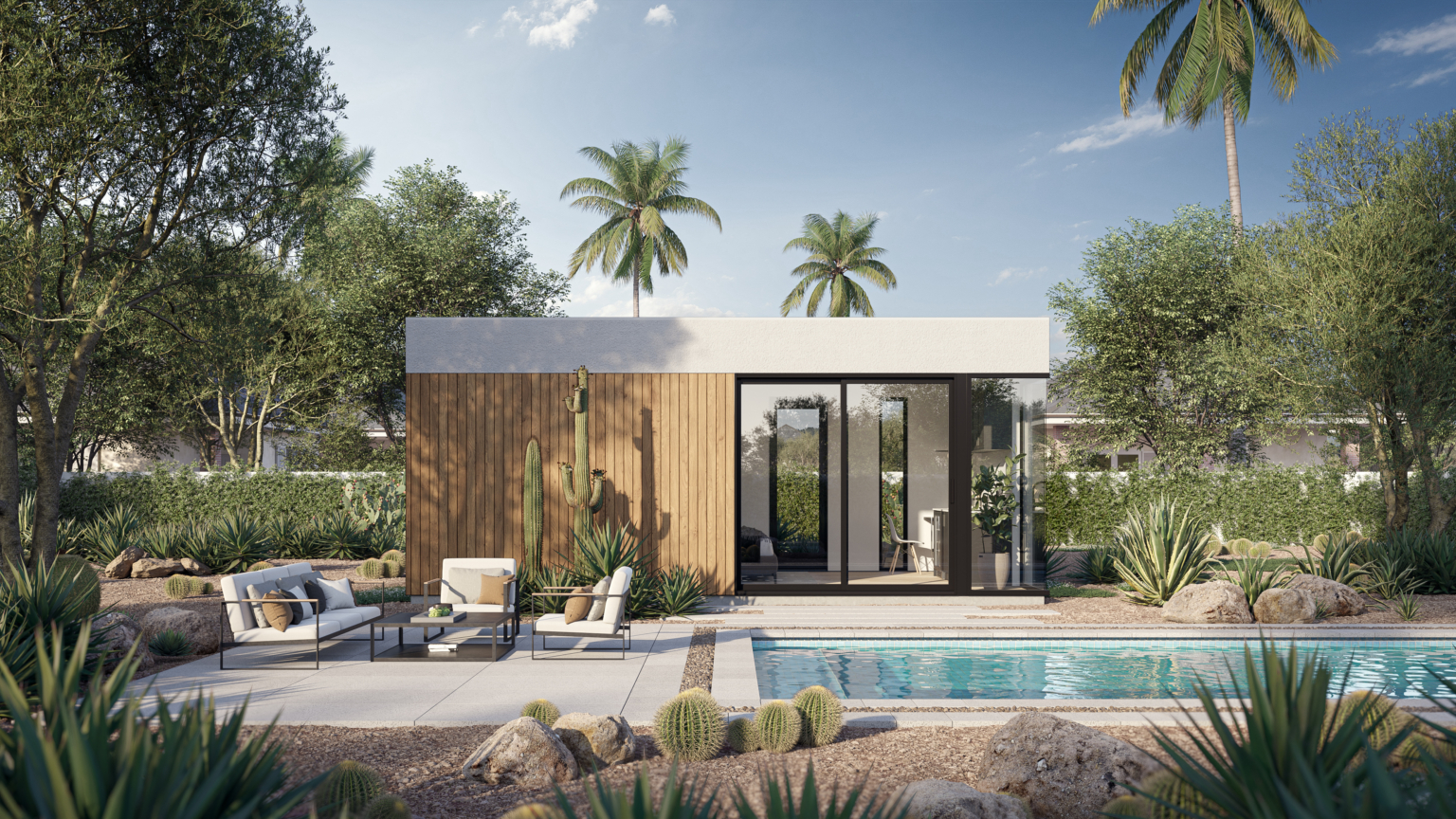
In this last summer’s roaring heat (it was definitely above 100 degrees), I was standing in a client’s backyard near Camelback Mountain, watching the late afternoon sun cast long shadows across their pool deck, which led to their poolhouse.
Their grown children had long since left for college, but the pool remained, a brilliant blue reminder of countless birthday parties and weekend gatherings.
Something was missing from the picture, though.
And I was there to help them take that poolhouse, which at the time was a storage space for a pile-up of pool floaties, and spin it into a waterside oasis.
That was, by a long shot, not the only poolhouse I worked on that summer, which speaks to how popular they’re becoming across Arizona right now.
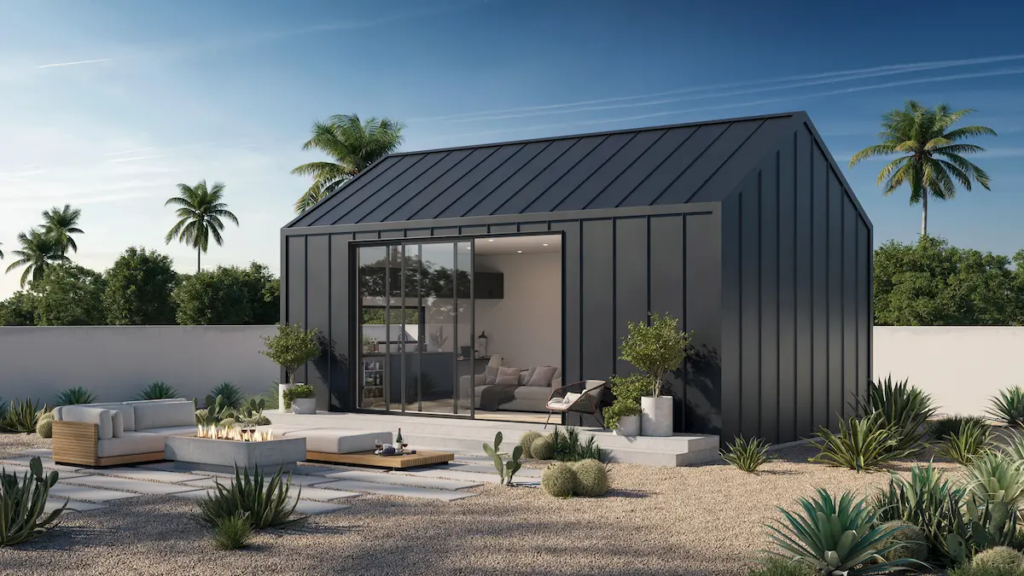
The poolhouse is a popular choice, and it’s evolving from simple utility structure to dreamy, breezy living space.
And I’ve come to see that it can really be the beating heart of outdoor living, that there are so many more possibilities today than there have ever been for poolhouses.
Let’s explore what’s possible beside the pool.
Today’s Popular Poolhouse
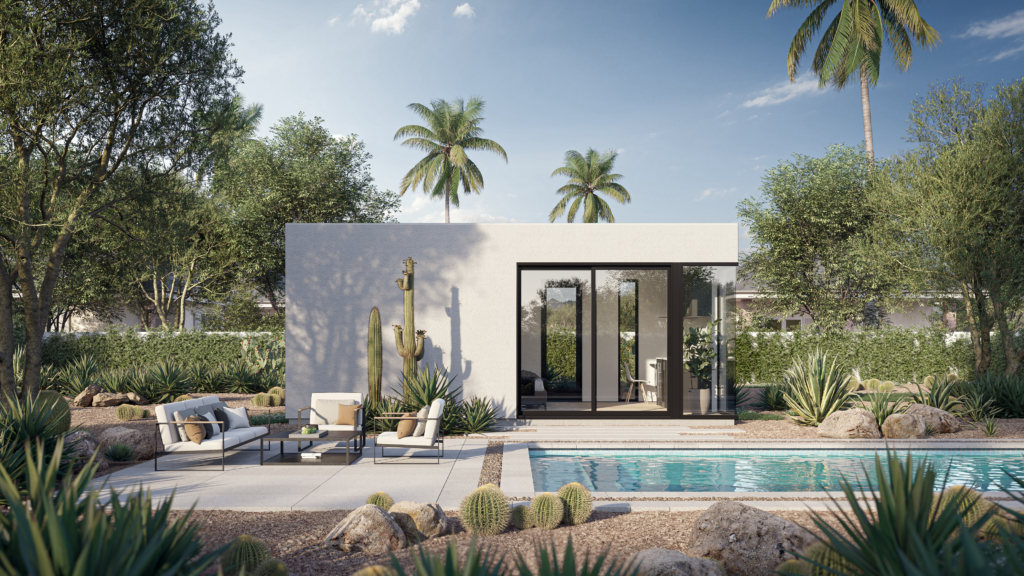
The traditional poolhouse served a purely functional role, as a place to change clothes, store chemicals, and perhaps grab a cold drink.
But today’s poolhouses are taking new forms.
According to research from the Global Accessory Dwelling Unit Market, the ADU market has grown from $18 billion in 2024 to a projected $19.65 billion in 2025, with a compound annual growth rate of 9.19%.
There’s been a shift in how homeowners think about auxiliary structures, clearly.
What explains this dramatic evolution?
My gut feeling is that the answer lies in the convergence of several 2025 trends:
First, remote work has altered our relationship with home spaces.
Second, multigenerational living has become increasingly common as families seek alternatives to expensive senior care facilities.
Third, the potential for rental income has transformed poolhouses from pure expense to potential investment.
When you combine these factors with Arizona’s year-round outdoor living climate, the modern poolhouse is quite a natural solution to multiple challenges (a reality that aligns with why building a home in Arizona means thinking beyond the main house in the first place).
Unlike the prefab solutions many assume dominate this market, we’ve discovered that traditional construction methods offer superior flexibility and value for poolhouse projects.
Traditional construction allows us to navigate the unique challenges of poolside environments while maximizing the structure’s potential as a true accessory dwelling unit.
While modular homes are Phoenix’s smartest solution for many applications, poolhouses benefit from the customization that site-built construction provides.
The Arizona Context: Desert Meets Water
Building near water in the desert presents challenges that have to be taken into account for the best product.
The Sonoran Desert’s extreme temperature swings, from 120-degree summer days to near-freezing winter nights, create thermal stress that can destroy poorly designed structures.
Construction costs have reached $162 per square foot nationally, with significant regional variations.
In Phoenix, where construction costs remain relatively moderate at $218 per square foot for multifamily construction, the key lies in selecting materials that can withstand both intense UV radiation.
Understanding how much it costs to build a house in Arizona helps set realistic expectations for poolhouse projects as well.
This is where we believe our expertise with traditional construction methods becomes particularly valuable.
We specify acrylic concrete coatings designed specifically for Arizona’s climate, providing heat-reflective and non-slip surfaces that keep pool decks comfortable even in peak summer.
These same principles extend to the poolhouse structure itself, where we employ deep overhangs, strategic window placement, and enhanced insulation to create comfortable interior spaces without excessive cooling costs.
In terms of landscaping, desert-adapted plants like palo verde trees provide essential shade while consuming minimal water.
We position these elements to create natural windbreaks and shade patterns that protect the structure while enhancing the overall aesthetic.
The Poolhouse as Strategic Investment
The economics of poolhouse construction have taken a bit of a swing recently.
According to Angi’s 2025 data, new construction costs average $150 per square foot nationally, with luxury features potentially pushing costs to $500 per square foot or more.
For a 600-square-foot poolhouse in Phoenix, construction costs typically range from $185,000 to $235,000, depending on finishes and features.
Still, when configured as a legal accessory dwelling unit, this same structure can generate substantial returns.
Recent market analysis shows ADU rental income ranging from $1,940 to $2,600 monthly for long-term rentals, with short-term vacation rentals potentially generating up to $5,000 monthly in prime locations.
In my mind, the versatility of a well-designed poolhouse creates what economists call “option value.”
That’s the ability to adapt the space as circumstances change.
Today’s rental unit might become tomorrow’s home office, next year’s guest suite for aging parents, or eventually return to generating rental income when family needs shift yet again.
Design Philosophy for Dual-Purpose Excellence
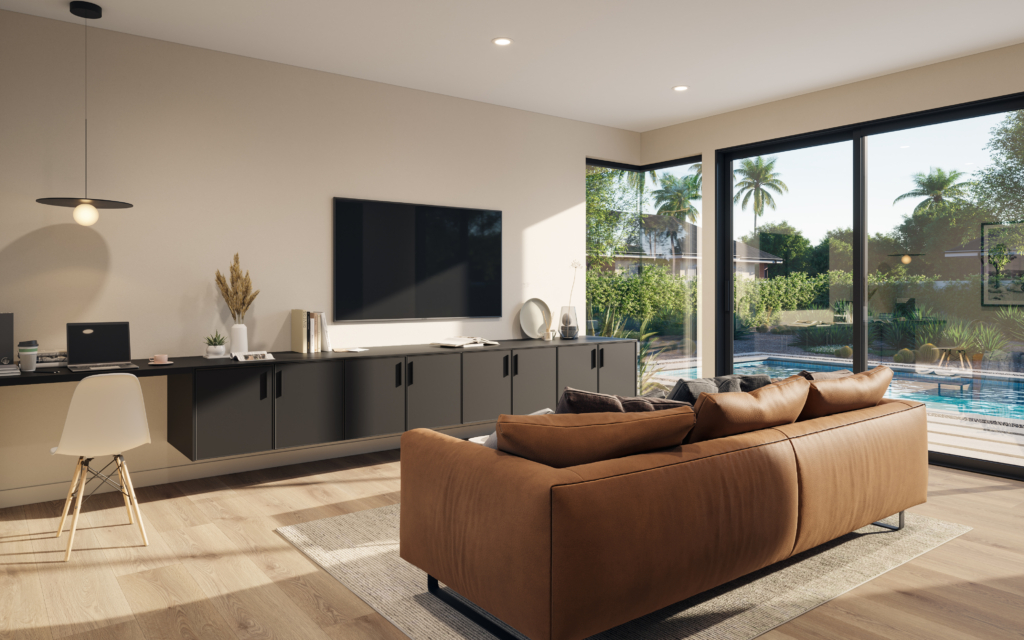
Creating a poolhouse that is dreamy for both poolside service and independent living requires a consideration of the inherent tension between these roles.
A structure optimized solely for pool use might feature large pass-through windows, minimal insulation, and water-resistant materials throughout.
Conversely, a pure ADU prioritizes privacy, energy efficiency, and residential comfort.
The modern poolhouse must, I believe, achieve both.
We typically position the structure to create distinct spatial zones, a pool-facing area with easy access for wet feet and casual gatherings, and a more private section suitable for overnight guests or long-term residents.
Technology integration has become essential to modern poolhouse design too.
ADU market research indicates that 45% of new ADUs incorporate smart home technologies, with this percentage rising to nearly 60% for poolhouse configurations.
Smart locks allow homeowners to provide temporary access codes for pool maintenance or short-term renters.
Climate control systems can be programmed to maintain different temperatures for different uses (cooler during pool parties, more moderate for overnight guests).
If you want a kitchen, there are a few considerations.
Counter to conventional wisdom, your ADU kitchen renovation costs less than you think when approached strategically.
We specify commercial-grade mini appliances that deliver full functionality in compact footprints, like induction cooktops provide precise temperature control without excessive heat generation.
Drawer dishwashers offer flexibility for both small daily loads and larger entertainment needs.
And of course, material selection balances durability with comfort.
For instance, porcelain tile flooring withstands wet feet and pool chemicals while maintaining residential warmth, and quartz countertops resist staining from sunscreen and drink spills.
The Luxury Integration: Poolhouses as Estate Anchors
For luxury properties, the poolhouse has evolved beyond auxiliary structure to become an essential component of estate planning.
This evolution reflects broader trends in the art of luxury home renovations, where outdoor living spaces receive equal attention to interior environments.
High-end poolhouses increasingly incorporate wellness amenities (infrared saunas, cold plunge pools, meditation spaces, and home gyms).
The proximity to the pool creates natural synergies for health-focused designs.
Morning yoga sessions flow seamlessly into lap swimming, for example, while post-workout recovery happens steps from exercise equipment.
Wine storage has also seemed to come up as a very popular luxury feature.
And it’s not a bad approach, given that the temperature-controlled environment necessary for pool equipment rooms perfectly suits wine cellar requirements.
Why not make it a combo, perfect for gatherings?
A poolhouse’s structural separation from main houses can also leave room for some exciting, bold architectural statements that might overwhelm primary residences.
To give some ideas, we’ve incorporated gallery walls, sculpture niches, and even rotating display systems that allow collections to evolve with seasons or occasions.
The Construction Timeline
Many clients underestimate the time required for quality poolhouse construction, leading to frustration when projects extend beyond initial estimates.
While timelines of course vary for how long it takes to build an ADU, with poolhouse projects specifically, typical timelines ranging from 7-10 months from initial consultation to move-in ready.
The design phase typically takes about 6-8 weeks, involving multiple iterations as we refine plans to balance desires with constraints.
Permitting adds another 8-12 weeks in most jurisdictions, though complex sites or variance requests can extend this timeline.
We submit applications with comprehensive documentation, anticipating common questions to minimize review cycles.
Then, there’s the construction itself, which typically spans 16-20 weeks for a standard 600-square-foot poolhouse.
Of course, this timeline assumes normal weather conditions and material availability.
And we’ve got to protect pool equipment, maintain water quality, and ensure swimmer safety throughout construction all the way.
These considerations, although they can occasionally add a bit of time, prevent costly damage and liability issues that will be well-worth the forethought a couple of years down the line!
The Two-Story Advantage
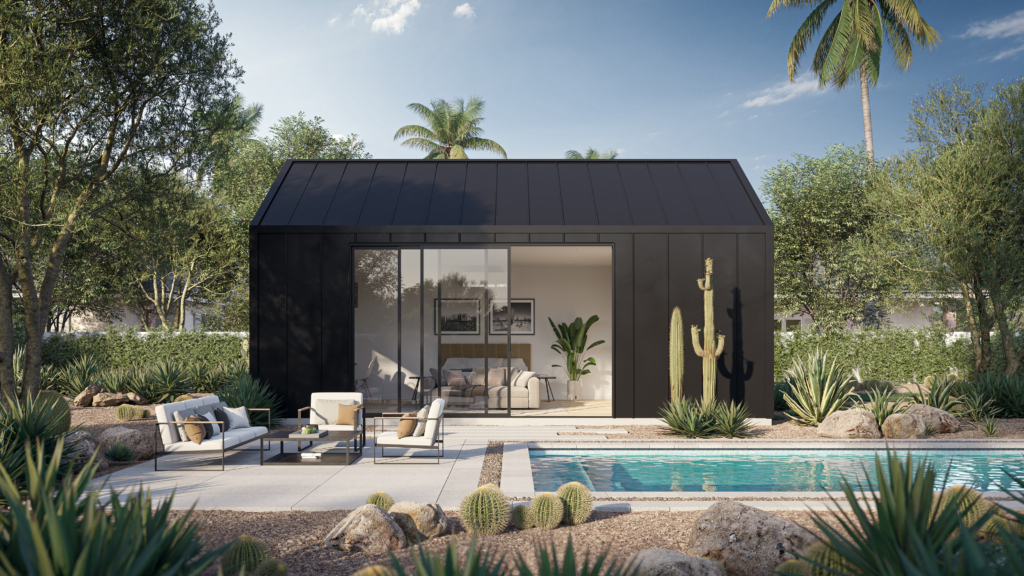
While single-story poolhouses dominate the market, two-story designs offer compelling advantages for certain properties.
Vertical construction maximizes limited footprints, particularly valuable in established neighborhoods with small lots.
The upper level provides separation between entertainment and living spaces, allowing simultaneous use without conflict.
This configuration has become increasingly popular, paralleling the rise of 2-story modular homes and why Phoenix is embracing factory-built innovation in residential construction.
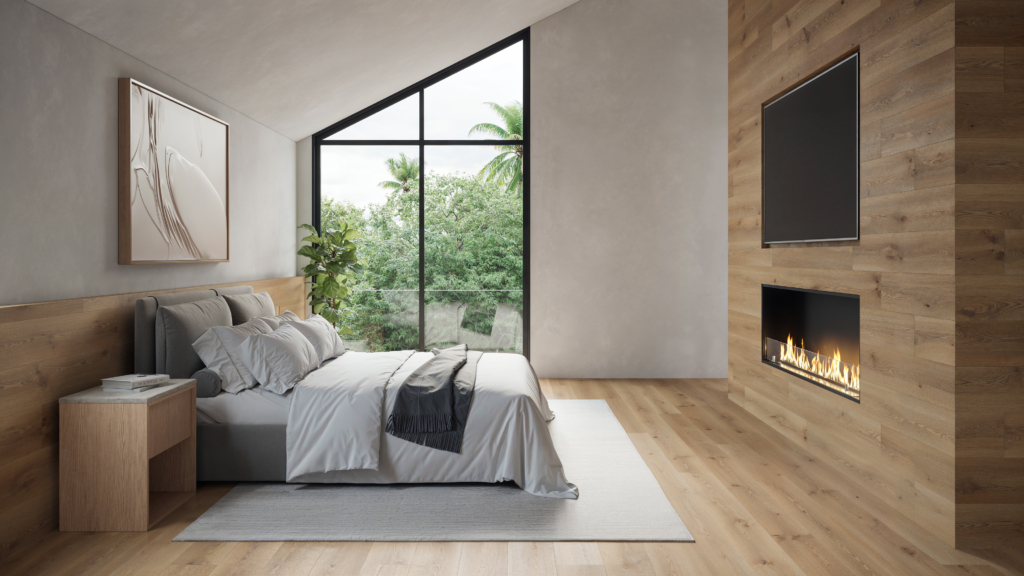
Upper-level bedrooms capture cooling breezes and offer privacy from pool activities.
We often position these spaces to overlook both pool and landscape, creating treehouse-like retreats that feel removed from ground-level activity.
And carefully designed stairs, either exterior or interior, can provide access while maintaining the structure’s dual-purpose flexibility.
Future-Proof
Building for tomorrow requires anticipating changes we can’t fully predict today.
Climate projections suggest Arizona summers will grow hotter and longer, with more extreme temperature events.
The Union of Concerned Scientists projects Phoenix could experience 50% more days above 110°F by 2050, and this will demand structures built not just for today’s climate but tomorrow’s extremes.
With that in mind, it’s our goal mow to specify materials and systems with extended temperature ranges, understanding that equipment rated for current conditions may fail under future stress.
For instance, enhanced insulation, typically R-30 in walls and R-38 in roofs, provides buffer against temperature extremes while reducing long-term operating costs.
You can also go for impact-resistant windows to protect against increasingly intense monsoon storms and to build in some added security.
Of course, flexibility in design allows spaces to evolve, and that’ll rely on some universal design principles (wider doorways, blocking for future grab bars, single-level construction) to ensure spaces can accommodate those changes.
Market projections suggest ADU demand will continue growing, with the global market expected to reach $43.35 billion by 2034.
To me, this suggests that poolhouses configured as ADUs will likely appreciate faster than traditional home improvements.
They’re an attractive investment for that reason, among many!
The Path from Vision to Reality
Transforming poolhouse dreams into built reality requires systematic planning and execution.
The process typically spans seven to eight months, though complex projects or challenging sites might extend this timeline.
Understanding each phase helps set realistic expectations and ensures smooth project progression.
Site evaluation initiates every project.
Not every property suits a poolhouse addition, and discovering constraints early prevents costly false starts.
We examine setback requirements, utility access, soil conditions, and tree preservation requirements.
Septic systems pose particular challenges, as health departments typically require significant separation between drain fields and new structures.
Our experience with over 100 ADU projects means we can quickly identify potential obstacles and develop solutions.
Design development transforms general ideas into specific plans, and this phase involves multiple iterations as we balance wish lists with budgets, dreams with regulations.
We’ve learned that transparency during this phase prevents disappointment later.
Our pricing structure clearly outlines costs for different options, allowing clients to make informed decisions about where to invest and where to economize.
And then, the permitting phase often frustrates clients who expect quick approvals for seemingly simple projects.
Still, poolhouses involve multiple departments, including planning, building safety, water resources, and sometimes health departments.
Our established relationships with permitting staff and deep understanding of requirements typically reduce approval time by 30-40% compared to first-time applicants.
Your Poolhouse Journey Begins Today
Whether you envision a simple poolside retreat or a full accessory dwelling unit with rental potential, a contemporary poolhouse is full of unprecedented opportunities to enhance your property and lifestyle.
The convergence of regulatory reform, technological advancement, and evolving social patterns makes this an optimal moment to consider a poolhouse addition.
With construction costs moderating from pandemic peaks and rental demand remaining strong, the financial case grows increasingly compelling.
But beyond the numbers, there’s a chance to create spaces that nurture the life you want to live.
How might a thoughtfully designed poolhouse address both?
This question deserves personal and careful consideration, informed by expertise, experience, and you or your family’s idiosyncrasies.
Ready to explore how a poolhouse could transform your property?
Our team brings deep expertise in both poolhouse design and ADU development, with a track record of over 100 successful projects across greater Phoenix.
Schedule a consultation to discover what’s possible in your backyard.